AI estimate as of June 21, 2025 · verify with a professional before acting
AI-Generated · Verify before acting
Everything on this page is generated by AI for informational purposes only. AI can make mistakes — the AI may misidentify items or misattribute them (artist, maker, brand, designer, origin, era). This is not an official valuation and should not be used for insurance, sale, tax, estate, legal, or lending purposes — or any decision requiring a certified appraisal. It is not an authoritative claim about any person, brand, or rights holder — do not share or rely on it as a factual statement about a third party. Always consult qualified professionals before making financial decisions.
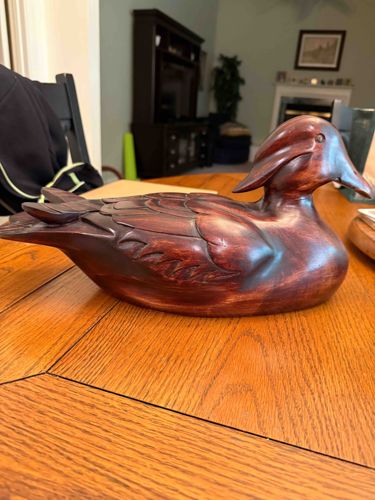
This expertly crafted item is a carved wooden duck decoy, featuring a rich, reddish-brown wood with visible grain patterns suggesting a hard timber like mahogany or cherry, possibly stained to achieve its deep color. It measures approximately 12-16 inches in length, consistent with the size of a typical decoy designed for display or hunting. The carving demonstrates a high level of craftsmanship, with smoothly contoured body parts, including a well-defined head, neck, and tail feathers. Details such as individual wing and tail feathers are articulated, though not excessively exaggerated, indicating a balance between realism and artistic interpretation. The eyes appear to be small, dark, possibly glass or painted, beads seamlessly set into the wood. The surface exhibits a glossy, polished finish, which helps to highlight the natural beauty of the wood and protect it. No significant wear or damage is visible; the piece appears to be in excellent condition with a well-maintained patina. There are no obvious manufacturing marks, signatures, or stamps visible in the provided image, which might imply a hand-carved, artisan-made piece rather than mass-produced. Given its style and apparent quality, it likely dates from the mid to late 20th century, representing a classic approach to duck decoy carving. The general aesthetic suggests a traditional, possibly American folk art style, often associated with waterfowl hunting heritage.
AI Appraisal Report
I have examined the image of this carved wooden duck decoy. Based on its appearance, the item presents in excellent condition with no visible damage or significant wear, suggesting careful handling and maintenance over time. The craftsmanship is evident in the smooth contours and articulated details, indicative of a skilled carver. The glossy finish highlights the wood's natural beauty and indicates good preservation. Authenticity, based solely on the image, appears to lean towards a hand-carved, artisan-made piece from the mid to late 20th century, which aligns with traditional American folk art.My assessment of market conditions for decorative duck decoys shows a steady demand, particularly for well-crafted, vintage pieces. Comparable sales of similar quality, artist-made wooden decoys in excellent condition typically range from $200 to $600, depending on the carver's reputation and specific stylistic elements. While this piece possesses good quality, the absence of an identifiable carver's signature or maker's mark limits its potential to reach the higher end of this range, as signed works by renowned carvers command premium prices.Its rarity is moderate; while not a one-of-a-kind piece, its quality elevates it above mass-produced items. The primary factor impacting value is the lack of a known artist. Without a signature or provenance, it functions more as a decorative folk art item than a highly collectible work by a specific master. To fully authenticate its origin, carver, and precise age, an in-person examination would be critical to check for hidden marks or construction techniques, and provenance documentation (e.g., sales receipts, family history) would be invaluable. Scientific testing of the wood or finish could also provide more precise dating.