AI estimate as of November 25, 2025 · verify with a professional before acting
AI-Generated · Verify before acting
Everything on this page is generated by AI for informational purposes only. AI can make mistakes — the AI may misidentify items or misattribute them (artist, maker, brand, designer, origin, era). This is not an official valuation and should not be used for insurance, sale, tax, estate, legal, or lending purposes — or any decision requiring a certified appraisal. It is not an authoritative claim about any person, brand, or rights holder — do not share or rely on it as a factual statement about a third party. Always consult qualified professionals before making financial decisions.
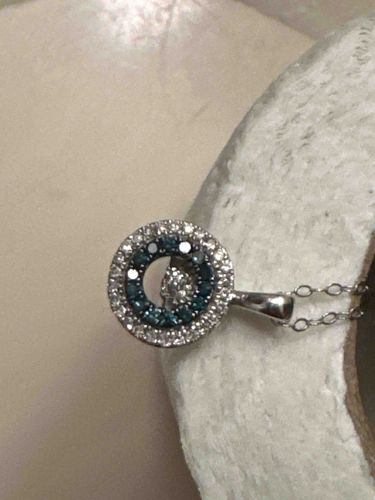
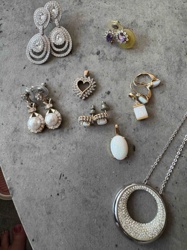
This exquisite piece is a two-tone diamond circle pendant, featuring an outer ring set with numerous small, colorless, round brilliant cut diamonds, and an inner, slightly offset, crescent-shaped ring of small, round brilliant cut diamonds in a distinct blue hue. The central area of the pendant is occupied by a cluster of colorless diamonds, creating a sparkling focal point within the blue crescent. The overall shape is a circular design with a dynamic, spiral-like internal arrangement of diamonds. The pendant is crafted from what appears to be white gold or platinum, judging by its silvery-white luster, and is suspended on a delicate, fine-link chain, also made of a similar white metal, suggesting a cohesive design. The bail connecting the pendant to the chain is a simple, polished loop. The diamonds are likely pavé-set, given their small size and close arrangement, maximizing sparkle and coverage. The item appears to be in good condition with no visible damage, significant wear, or missing stones. The metal shows a clean, bright finish, indicative of either careful wear or recent cleaning. The craftsmanship appears to be of good quality, with precise stone setting and a well-finished metallic surface, characteristic of modern fine jewelry. This piece likely dates from the late 20th to early 21st century.
AI Appraisal Report
Upon visual examination of the provided image, I assess this two-tone diamond circle pendant necklace to be in good condition. The metal exhibits a bright, clean finish, and all stones appear securely set with no visible damage or missing elements. The craftsmanship suggests a modern piece, likely late 20th to early 21st century, with good quality pavé setting ensuring maximum sparkle. Authenticity of materials, specifically the diamonds and metal, cannot be definitively confirmed without in-person inspection and testing. While the colorless diamonds appear to be natural based on their brilliance, the blue coloration of the crescent diamonds could be natural Fancy Blue or treated. Similarly, the white metal requires testing to distinguish between white gold and platinum.
In terms of market conditions, diamond circle pendants remain a popular and timeless jewelry style, appealing to a broad demographic. The addition of blue diamonds offers a unique design element that enhances its individuality. Comparable pieces with similar diamond carat weight, metal type, and design complexity typically retail in the $1,800 to $3,000 range. Factors impacting value significantly include the total carat weight of the diamonds (which I can't ascertain precisely from an image), the exact quality (cut, color, clarity) of both the colorless and blue diamonds, and whether the blue diamonds are natural or treated. The apparent good condition and appealing design contribute positively to its marketability. Demand for such versatile diamond pendants is consistent.
For full authentication and a more precise valuation, a physical examination would be crucial. This would involve evaluating the diamonds for precise carat weight, color, clarity, and confirming the origin of the blue color (natural vs. treated). Metal testing is also necessary to confirm whether it is white gold or platinum, and to determine its purity.