AI estimate as of June 27, 2025 · verify with a professional before acting
AI-Generated · Verify before acting
Everything on this page is generated by AI for informational purposes only. AI can make mistakes — the AI may misidentify items or misattribute them (artist, maker, brand, designer, origin, era). This is not an official valuation and should not be used for insurance, sale, tax, estate, legal, or lending purposes — or any decision requiring a certified appraisal. It is not an authoritative claim about any person, brand, or rights holder — do not share or rely on it as a factual statement about a third party. Always consult qualified professionals before making financial decisions.
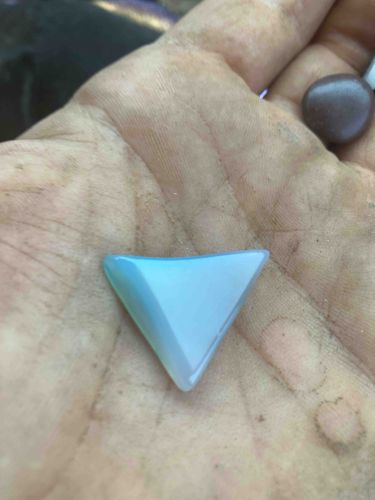
This item is a meticulously cut and polished triangular cabochon, likely intended for use as a focal point in jewelry such as a pendant or ring. Its primary characteristic is its striking light blue color, exhibiting a subtle translucency that allows light to penetrate, revealing a delicate opalescence or internal glow. The hue transitions gently from a slightly deeper blue at one edge to a softer, almost milky pale blue or sky-blue towards the opposite end, suggesting either natural color zoning within a mineral or a deliberate artistic effect. The piece is perfectly equilateral in shape, with distinct but softly rounded edges and a domed, highly polished top surface, which reflects light beautifully, giving it a lustrous, almost glass-like sheen. It appears to be made from a natural stone, possibly chalcedony (like blue lace agate or aqua chalcedony) or a similar silicate mineral due to its color and translucence. Measuring approximately 2-3 cm along each side, it is presented in excellent condition, with no visible chips, cracks, scratches, or other forms of damage or wear to its pristine polished surface. There are no noticeable inclusions or internal flaws from the visible image. The high quality of the cut and polish indicates skilled lapidary craftsmanship, emphasizing the stone's inherent beauty and color play. No maker's marks or signatures are visible, which is typical for individual cut gemstones. Its clean lines and vibrant yet gentle color make it suitable for a wide range of contemporary or classic jewelry designs.
AI Appraisal Report
Upon my visual examination of the provided description, this triangular blue translucent cabochon presents as a meticulously crafted and beautiful lapidary item. Its excellent condition, showing no chips, cracks, or surface wear, is remarkable and speaks to its careful handling and quality. The described subtle translucency, delicate opalescence, and attractive light blue hue transitioning gently across the surface are highly desirable characteristics for a gemstone intended for jewelry.
Based on its visual properties, particularly the color and translucency, I assess this cabochon as likely composed of a natural silicate mineral, consistent with high-grade chalcedony, possibly blue lace agate or aqua chalcedony. The quality of the cut, its perfectly equilateral shape, and the high polish indicate skilled lapidary craftsmanship, significantly enhancing its aesthetic appeal and market value. Its size, approximately 2-3 cm per side, makes it a substantial and impactful piece for a pendant or statement ring.
Market demand for well-executed and uniquely shaped natural stone cabochons remains strong, particularly for those exhibiting superior color and excellent condition. While chalcedony is not considered a rare mineral, pieces with such clarity, consistent color, and professional cutting are less common and command a premium. This particular item's pristine condition and aesthetic qualities are significant value drivers.
However, it is crucial to note the inherent limitations of appraising solely from a description. While the reported visual characteristics strongly suggest a natural chalcedony, definitive authentication of the stone type, origin, and absence of treatments (such as dyeing or heat enhancement) cannot be made without a physical in-person examination. A full appraisal would require hands-on inspection to assess specific gravity, refractive index, and microscopic internal features, along with potential scientific testing by a gemological laboratory. Provenance documentation would also add significant verifiable history.