AI estimate as of October 5, 2025 · verify with a professional before acting
AI-Generated · Verify before acting
Everything on this page is generated by AI for informational purposes only. AI can make mistakes — the AI may misidentify items or misattribute them (artist, maker, brand, designer, origin, era). This is not an official valuation and should not be used for insurance, sale, tax, estate, legal, or lending purposes — or any decision requiring a certified appraisal. It is not an authoritative claim about any person, brand, or rights holder — do not share or rely on it as a factual statement about a third party. Always consult qualified professionals before making financial decisions.
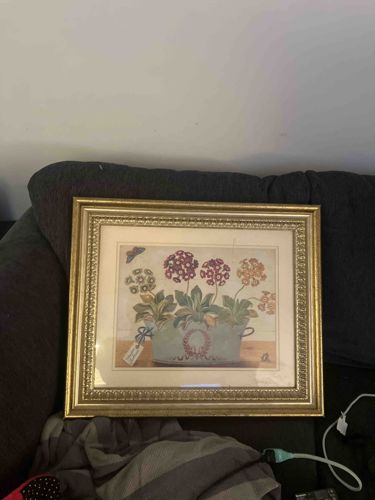
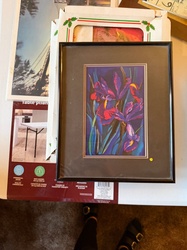
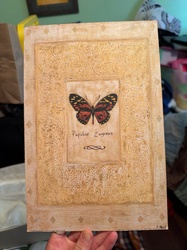
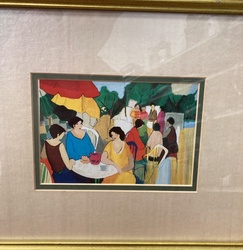
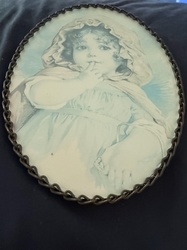
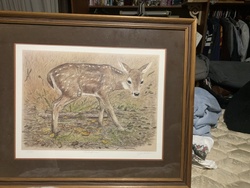
This item is a framed decorative art print depicting a floral still life. The print features a light blue or greenish-blue planter or bucket containing several clusters of flowers. The flowers are varied in color, with prominent clusters of reddish-purple, green-yellow, and orange-yellow blooms, each with green foliage. A small brown butterfly is visible in the upper left corner of the print, and a small tag or label tied with a blue ribbon is hanging from the front of the planter. The background appears to be a light, somewhat textured surface, possibly suggesting a wall or fabric, with a wooden surface below the planter. The print is housed within an ornate gold-colored frame, which features a detailed, possibly molded, relief pattern around its inner and outer edges, suggesting a traditional or classic aesthetic. The print itself appears to be under glass or acrylic, protecting it from dust and damage. The frame exhibits a glossy or semi-glossy finish, enhancing its decorative appeal. There are no clear visible condition issues such as major scratches, dents, or discolorations on the frame or the print itself from the provided image, though detailed inspection would be required to confirm. The frame appears sturdy and well-constructed, indicative of a mass-produced decorative item. The overall style suggests a contemporary decorative piece, likely from the late 20th or early 21st century, designed to add a touch of color and natural theme to interior decor. No visible artist's signature or specific manufacturing marks are discernible from the image.
AI Appraisal Report
Based on my visual examination of the provided image, this item is a framed decorative art print depicting a floral still life. The print itself appears to be in good condition, protected by glass or acrylic. The ornate gold-colored frame, while decorative, appears to be mass-produced, likely from a molded composite material, and exhibits no immediately visible damage or significant wear. The overall aesthetic suggests a contemporary decorative piece, likely manufactured in the late 20th or early 21st century.
Market conditions for such mass-produced decorative prints are generally low. These items are common in home decor stores, department stores, and online retailers. Comparables would include similar framed floral prints, often sold new for $50-$150, depending on size and retailer. In the secondary market (thrift stores, online marketplaces for used goods), their value typically depreciates significantly.
Demand for generic decorative art, even if aesthetically pleasing, is broad but not necessarily strong enough to command high prices, as supply is plentiful. Rarity is not a factor here; this is a widely distributed decorative item. Factors impacting value negatively include its mass-produced nature and the absence of any discernible artist's signature, limited edition markings, or historical significance.
My assessment of authenticity is limited to what can be observed visually. From the image, it is clearly a decorative print and not an original artwork. Without physical inspection, I cannot confirm the material composition of the frame, the printing method used for the art, or rule out minor imperfections like scuffs or scratches in the frame finish or dust beneath the glass. Full authentication or a more precise condition report would require in-person examination to assess frame material, print quality, and overall structural integrity, as well as checking for any hidden markings or labels. Provenance documentation would be necessary to trace its origin or confirm any potential artist if applicable, though it's highly unlikely for such an item.