These notes were written by the person who submitted this item. Appraiser.AI has not verified them, and the AI's identification and estimate may rely on them.
AI Estimated Value
Not an official valuation
$25-50
AI estimate as of August 2, 2025 · verify with a professional before acting
AI-Generated · Verify before acting
Everything on this page is generated by AI for informational purposes only. AI can make mistakes — the AI may misidentify items or misattribute them (artist, maker, brand, designer, origin, era). This is not an official valuation and should not be used for insurance, sale, tax, estate, legal, or lending purposes — or any decision requiring a certified appraisal. It is not an authoritative claim about any person, brand, or rights holder — do not share or rely on it as a factual statement about a third party. Always consult qualified professionals before making financial decisions.
This analysis also relies on unverified notes provided by the user, which may be incomplete or inaccurate and could affect the result.
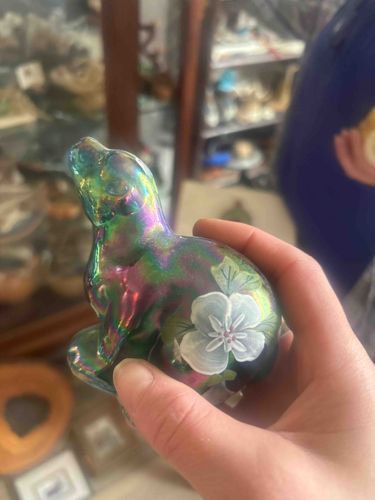
This item is a decorative figurine, appearing to be a stylized representation of an animal, likely a polar bear or a similar Alaskan fauna, given the iridescent finish, which often evokes ice or the aurora borealis, and the context of 'Alaskan art'. The figurine is crafted from a material that gives it an iridescent, rainbow-like shimmer, shifting in color from purples, blues, and greens to hints of gold depending on the light and viewing angle. This effect is characteristic of carnival glass or similar treated glass, a ceramic with a specialized glaze, or possibly a resin with a comparable finish. The form is smooth and rounded with minimalistic features, depicting the animal in a seated or reclining pose, looking upwards. Its approximate size appears to be suitable for holding in one hand, suggesting a small to medium-sized collectible. A prominent feature is a hand-painted floral design on its side, depicting a white flower with delicate petals and a pink or red center, surrounded by green leaves. This flower strongly resembles the Forget-Me-Not, Alaska's state flower, further supporting its connection to Alaskan art and themes. The painting appears well-executed with clear detail, suggesting careful craftsmanship. No visible significant damage such as chips, cracks, or repairs are apparent from the image, indicating good condition, though a full inspection would be required to confirm this. The quality of the iridescent finish and painted detail suggests it is a manufactured decorative item, likely from the late 20th century or early 21st century, often produced for the tourist or souvenir market in areas known for specific regional motifs. The overall aesthetic is charming and collectible.
AI Appraisal Report
Upon examining the provided image of the Iridescent Animal Figurine with Floral Motif (Alaskan Theme), I observe an item in excellent visual condition. No apparent chips, cracks, or repairs are visible, and the iridescent finish appears intact and vibrant. The hand-painted floral detail, resembling Alaska's state flower, the Forget-Me-Not, is well-executed with clear precision. Based on its aesthetic and the 'Alaskan art' context provided, it strongly aligns with manufactured decorative items often produced for the tourist or souvenir market, likely dating from the late 20th to early 21st century.
Market conditions for such contemporary decorative figurines, even with regional themes, are generally stable but do not command high values unless associated with a particularly renowned artist or limited production. Comparable items, often found in souvenir shops or online marketplaces, typically fall into the lower-to-mid range for collectibles. Demand is primarily from those with an affinity for Alaskan themes or collectors of iridescent glass/ceramic items. Rarity is low, as these types of items were likely mass-produced.
The primary factor impacting value is its decorative appeal and association with Alaskan themes. However, without a maker's mark, signature, or provenance documentation, its specific origin and authenticity as a unique 'Alaskan art' piece, beyond a tourist item, cannot be definitively established from images alone. An in-person examination would allow for tactile assessment of material, closer inspection for subtle defects, and search for hidden marks. Provenance documentation, such as original sales receipts or certificates, would be crucial for verifying any claims of limited edition or specific artisan craftsmanship. Scientific testing would be excessive for an item in this category.