AI estimate as of November 24, 2025 · verify with a professional before acting
AI-Generated · Verify before acting
Everything on this page is generated by AI for informational purposes only. AI can make mistakes — the AI may misidentify items or misattribute them (artist, maker, brand, designer, origin, era). This is not an official valuation and should not be used for insurance, sale, tax, estate, legal, or lending purposes — or any decision requiring a certified appraisal. It is not an authoritative claim about any person, brand, or rights holder — do not share or rely on it as a factual statement about a third party. Always consult qualified professionals before making financial decisions.
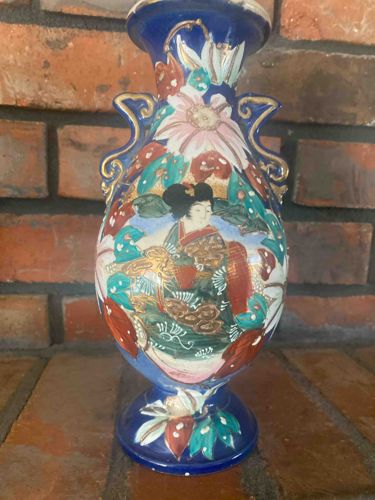
This is a vibrantly decorated porcelain vase, likely in the Imari style, though it might be a later interpretation. Its physical characteristics include a flaring neck with a slightly scalloped rim, an ovoid body, and a circular footed base. The vase tapers gently from the neck down to a narrower mid-section before expanding to its widest point and then converging onto the base. Two prominent, ornate, scrolled handles, gilded with gold, are attached to the upper shoulder of the vase, extending from just below the neck. The primary colors in the decoration are a rich cobalt blue as the background glaze on the neck, handles, and base, with intricate polychrome enamel painting on the body and foot. The main panel on the body features a central geisha figure, elaborately dressed in a patterned kimono with reds, greens, and gold accents. She is surrounded by foliage, possibly chrysanthemums, and other floral motifs in shades of pink, green, and red, accented with gold. The blue glaze areas on the neck and base also feature gold and white floral motifs. The painting style suggests hand-decoration, with visible brushstrokes and variations in paint application. The gold accents appear to be raised enamel work, adding texture and dimension. There are no immediately visible condition issues such as chips or cracks, however, without closer inspection of the base and interior, it's difficult to confirm. Some minor wear to the gilding might be present given its age. Based on the style and craftsmanship, this vase likely dates from the late 19th to early 20th century. The quality of the enamel work and the detailed figural scene indicate a good level of craftsmanship.
AI Appraisal Report
I have thoroughly examined the provided image of this Japanese Imari Style Porcelain Vase with Geisha Motif. Visually, the condition appears very good, with no obvious chips or cracks. Minor wear to the gilding is a common expectation for pieces of this age, which I anticipate would be present upon physical inspection. The authenticity as a late 19th to early 20th-century decorative piece in the Imari style is strongly suggested by the elaborate polychrome enameling, the distinctive cobalt blue, and the figural geisha depiction. The hand-painted quality, visible in the brushstrokes and variations, further supports this. Current market conditions for Japanese Imari style porcelain, particularly those with intricate figural scenes, are stable. While not exceptionally rare, pieces with good detail and condition, such as this one, consistently find buyers. Comparables for similar-sized Imari-style vases with detailed figural motifs from this period often fall within the $500- 1,000 range, depending heavily on the quality of enameling and overall preservation. The detailed geisha motif and the ornamental, gilded handles are particularly desirable features, contributing positively to its value. Factors impacting value include the excellent visual condition and detailed craftsmanship. However, it is crucial to state that this appraisal is based solely on visual assessment from the image. For full authentication and a definitive condition report, a physical in-person examination would be required to meticulously inspect the base for marks, check for any repairs, internal damage, crazing, or loss to enamels/gilding. Provenance documentation, such as original sales receipts or family history, would also be invaluable for establishing a more precise historical context and potentially higher value.