AI estimate as of June 22, 2025 · verify with a professional before acting
AI-Generated · Verify before acting
Everything on this page is generated by AI for informational purposes only. AI can make mistakes — the AI may misidentify items or misattribute them (artist, maker, brand, designer, origin, era). This is not an official valuation and should not be used for insurance, sale, tax, estate, legal, or lending purposes — or any decision requiring a certified appraisal. It is not an authoritative claim about any person, brand, or rights holder — do not share or rely on it as a factual statement about a third party. Always consult qualified professionals before making financial decisions.
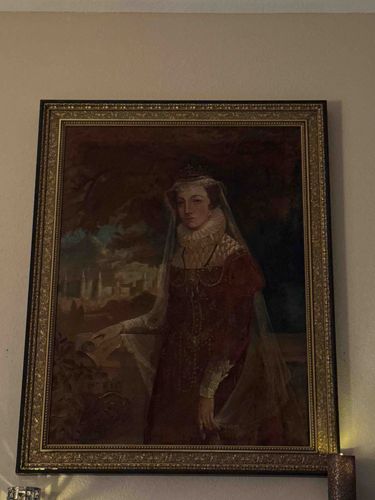
This item is a framed portrait painting, likely oil on canvas, depicting a noblewoman or queen in historical attire. The composition features a full-length, slightly off-center portrayal of the female subject against a dark, dramatic background that includes architectural elements resembling a distant castle or city on the left and a darker, less discernible landscape on the right. The overall color palette is rich and muted, dominated by deep reds, browns, and dark blues. The subject wears an elaborate costume with a prominent white ruff or high collar, a red or maroon long-sleeved gown adorned with intricate gold or light-colored embroidery and possibly pearls or jewels, and a sheer veil cascading down her back. A crown or diadem rests on her head, indicating high status. Her right hand rests on a book or scroll atop a draped surface, while her left hand is barely visible, holding the fabric of her gown. The frame is a substantial, ornate gilded wood with intricate carved or molded details, suggesting a traditional or antique aesthetic. Visible condition issues include potential dust accumulation on the frame and surface of the painting, and the colors appear somewhat subdued, which could be due to age, lighting, or a layer of old varnish. There are no immediate signs of significant damage like tears or severe cracking visible. The painting's style and the subject's attire suggest a European origin, likely from the Renaissance or Baroque period (16th-18th century), though it could also be a later historical revival piece. The quality of brushwork, while not perfectly clear in the image, appears to be of a professional standard, indicating a skilled artist.
AI Appraisal Report
Based on my visual examination of the provided image, this framed portrait painting, depicting a noblewoman or queen, presents as a charming and historically-inspired piece. The overall condition appears consistent with an aged artwork; I observe potential dust accumulation on both the ornate gilded frame and the painting's surface, as well as a subdued color palette that suggests either age-related fading, an old varnish layer, or specific lighting conditions during photography. While no significant damage like tears or severe cracking is immediately visible, a thorough in-person inspection would be critical to confirm structural integrity and surface stability. Authenticity, particularly regarding its age and artist, cannot be definitively ascertained from images alone. The style suggests a European origin, possibly 16th-18th century, or a later revival piece. To confirm age and artist, I would require direct physical examination, including professional cleaning and varnish removal, pigment and canvas analysis, and thorough provenance documentation. Market conditions for historical portraits can vary widely depending on artist attribution, subject importance, and condition. While this piece possesses decorative appeal, the lack of a known artist or definitive historical significance limits its top-tier market potential. It is likely a decorative piece rather than a museum-quality artifact. Demand for such items is generally steady for decorative purposes, but rarity is hard to assess without further authentication. The ornate frame adds to its decorative value. The primary factors impacting value here are the unknown artist, unconfirmed age, and the need for professional conservation for optimal presentation. Without further authentication and physical assessment, it's challenging to place it in the higher echelons of the art market.