AI Appraisal Estimate

AI-generated estimates · not official valuations

From the user

What was submitted

Photo and notes provided by the user — not generated by AI

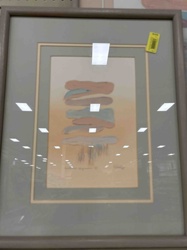
Submitted item photo
Submitted photo · June 3, 2026

User's notes

No additional notes provided.

AI analysis below

AI appraisal

AI analysis & estimate

AI-Generated · Verify before acting

Everything below is generated by AI for informational purposes only. AI can make mistakes — the AI may misidentify items or misattribute them (artist, maker, brand, designer, origin, era). This is not an official valuation and should not be used for insurance, sale, tax, estate, legal, or lending purposes — or any decision requiring a certified appraisal. It is not an authoritative claim about any person, brand, or rights holder — do not share or rely on it as a factual statement about a third party. Always consult qualified professionals before making financial decisions.

Read the full disclaimer

AI Identification

·Not independently authenticated·Verify before acting

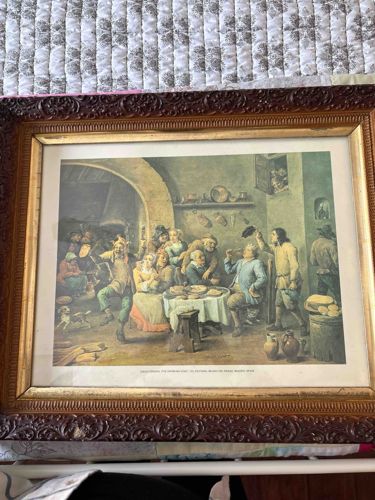
Framed Print of David Teniers the Younger's 'The King Drinks' (Le Roi Boit)

Wall Art & Prints

AI Estimated Value

·Not an official valuation·Verify before acting

$75 - $125

As of June 3, 2026

AI Item Analysis

·AI can make mistakes·Verify before acting
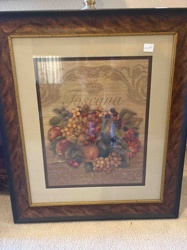
This is a framed color lithograph or offset print depicting a boisterous 17th-century interior tavern scene, originally painted by the Flemish Baroque master David Teniers the Younger. The scene illustrates the Twelfth Night celebration known as 'The King Drinks,' featuring a group of peasants gathered around a table; a central figure in a blue coat and crown toasts his companions while others sing and play instruments. The print is housed in a substantial, ornate composite or gesso-on-wood frame with a deep profile. The frame features a dark, heavily carved outer border with foliate and scroll motifs, transitioning to an inner gilded slip or liner. The print itself bears a caption at the bottom margin that identifies the work and the artist. Regarding condition, the frame shows visible wear including cracking in the gesso, several chips on the lower outer edge revealing lighter under-material, and overall dusting within the recesses of the carving. The print exhibits some mild undulation and possible light yellowing due to age, likely dating from the mid-20th century based on the framing style and printing quality. The piece reflects a traditional academic taste in art reproduction meant for home decor, showcasing high-contrast shadows and a characteristic muted earthy palette with pops of blue and red.
AI Appraisal Report

·AI can make mistakes·Verify before acting
I have examined the digital representation of this framed print. It is a mid-20th-century mass-produced lithograph or offset print of David Teniers the Younger’s 'The King Drinks.' The work reflects the popular decorative taste of the 1940s-60s, designed to emulate Old Master aesthetics for a residential setting. While the imagery is historically significant, this specific physical item is a reproduction rather than a period engraving or original work. The condition of the frame is fair to poor, showing significant gesso cracking and loss on the lower edge, which detracts from its display value. The print shows evidence of age-related yellowing and slight undulation, suggesting it may not be mounted on acid-free materials. In the current secondary market, such reproductions are common; their value is primarily decorative rather than as fine art investments. Demand for heavy, ornate traditional frames has softened in recent years, though they still appeal to specific collectors of 'shabby chic' or traditional tavern-style decor. Limitations: My assessment is based solely on high-resolution images. I cannot definitively verify the printing process (e.g., halftone dots vs. continuous tone) without a jeweler’s loupe. A physical inspection is required to determine if the print is laid down on board or if there is hidden foxing under the mat. To establish a higher valuation, provenance documentation or a confirmed gallery label from a known 19th-century dealer would be necessary. Scientific testing of the paper fibers would confirm whether the paper is wood-pulp-based or rag, further dating the piece.

Get your items appraised

Instant estimates of your treasures with AI-powered appraisals

Browse More Appraisals