AI estimate as of June 16, 2025 · verify with a professional before acting
AI-Generated · Verify before acting
Everything on this page is generated by AI for informational purposes only. AI can make mistakes — the AI may misidentify items or misattribute them (artist, maker, brand, designer, origin, era). This is not an official valuation and should not be used for insurance, sale, tax, estate, legal, or lending purposes — or any decision requiring a certified appraisal. It is not an authoritative claim about any person, brand, or rights holder — do not share or rely on it as a factual statement about a third party. Always consult qualified professionals before making financial decisions.
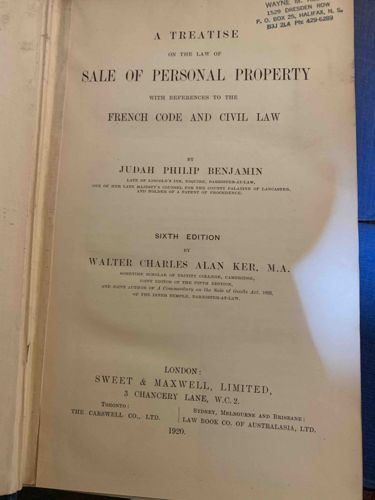
This is the title page of a book titled "A TREATISE ON THE LAW OF SALE OF PERSONAL PROPERTY WITH REFERENCES TO THE FRENCH CODE AND CIVIL LAW" by Judah Philip Benjamin. The image shows the title, author's name and credentials, and indicates that this is the Sixth Edition, edited by Walter Charles Alan Ker. The publication details reveal it was published in London by Sweet & Maxwell, Limited, and in Toronto by The Carswell Co., Ltd., and also lists Sydney, Melbourne, and Brisbane via Law Book Co. of Australasia, Ltd. The publication year is clearly stated as 1920. The page appears to be made of aged paper, exhibiting a uniform cream or off-white color characteristic of older book pages. There are no visible major tears, stains, or rips on this specific page, suggesting it is in relatively good condition considering its age. A faint marking, potentially a handwritten note or stamp, is present in the upper right corner, but it is partially obscured and difficult to fully decipher. The typography is clear and legible, using various font sizes and styles appropriate for a legal treatise of this period. The binding edge is visible on the left, showing the gutter and the means by which the page is attached to the book's spine (not visible). The overall impression is a well-preserved legal text from the early 20th century.
AI Appraisal Report
Upon visual examination of the provided image of the title page of the Sixth Edition of "A TREATISE ON THE LAW OF SALE OF PERSONAL PROPERTY" by Judah Philip Benjamin, published in 1920, I can assess its condition and potential value. The page appears to be in relatively good condition for its age, exhibiting the expected aging of paper but no prominent tears, stains, or rips. The typography is clear and legible, and the binding edge appears intact. A faint, partially obscured marking in the upper right corner is noted but its nature and impact on value cannot be fully determined from the image. This edition, being the Sixth and edited by Walter Charles Alan Ker, is a later printing of a significant legal work. Market conditions for such legal treatises from this period vary; while fundamental texts retain some value for their historical significance and academic interest, later editions are generally less valuable than the first editions due to increased availability. Demand is primarily within legal history circles, academic institutions, and collectors of important legal texts. This specific printing, while important in the lineage of the work, is not considered particularly rare. The primary factors impacting value are the book's overall condition (which appears good based on the title page), and the fact that it is a later edition. The faint marking, if an owner's signature or stamp, could add modest interest but not significant value unless it is from a notable legal figure. It is important to note the limitations of this authentication process based solely on an image. I can assess the appearance of the title page, determine the edition and publication details, and make an educated guess about the paper's condition. However, to verify the authenticity of the entire book, assess the condition of the other pages, binding, and confirm that the title page is indeed part of the original printing, a physical in-person examination is required. Provenance documentation, if available, would be beneficial for understanding the book's ownership history and further verifying its authenticity. Scientific testing would generally not be necessary for a book of this type and age unless there were questions about the paper or ink authenticity, which is not suggested by the image.