These notes were written by the person who submitted this item. Appraiser.AI has not verified them, and the AI's identification and estimate may rely on them.
AI Estimated Value
Not an official valuation
$30-50
AI estimate as of July 24, 2025 · verify with a professional before acting
AI-Generated · Verify before acting
Everything on this page is generated by AI for informational purposes only. AI can make mistakes — the AI may misidentify items or misattribute them (artist, maker, brand, designer, origin, era). This is not an official valuation and should not be used for insurance, sale, tax, estate, legal, or lending purposes — or any decision requiring a certified appraisal. It is not an authoritative claim about any person, brand, or rights holder — do not share or rely on it as a factual statement about a third party. Always consult qualified professionals before making financial decisions.
This analysis also relies on unverified notes provided by the user, which may be incomplete or inaccurate and could affect the result.
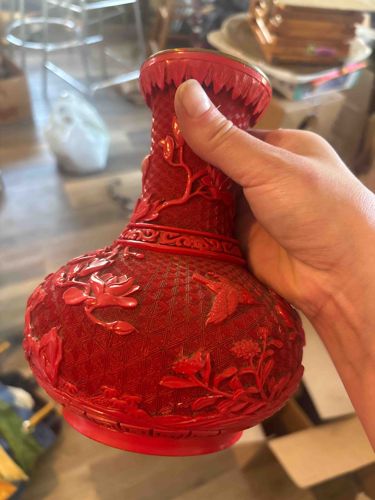
This item is a vibrant red carved cinnabar-style vase, likely made of resin or lacquered material given its uniform color and lack of typical cinnabar wear patterns. The vase features a bulbous body tapering into a slender neck, which then flares out slightly at the rim. Its surface is extensively decorated with relief carvings, showcasing various motifs. The central register of the body displays an intricate design, including what appears to be a bird in flight, possibly a hummingbird, amidst flowering branches with blooms and foliage. Another prominent floral element resembles a lotus or peony. The background of the carved areas is textured with a fine, geometric pattern, possibly a cross-hatch or wave design, which provides depth and contrast to the raised motifs. The neck of the vase also features floral vines and, towards the rim, a border with jagged, possibly stylized flame or leaf patterns. Around the base and just below the neck, there are additional decorative bands, possibly geometric or stylized scrollwork. The overall craftsmanship suggests a machine-made or cast quality with hand-finished details, as indicated by the uniform appearance. There are no obvious signs of significant damage, cracks, or repairs visible in the image, although a close inspection for minor wear or chipping would be necessary for a full appraisal. The color is a consistent, rich, deep red. The object's proportions suggest it is of a modest size, possibly between 6 to 10 inches tall, judging by its placement in a hand. Given the common production of such items, it likely dates to the mid-to-late 20th century, consistent with the 'Made in Taiwan' context.
AI Appraisal Report
Upon examining the images of this red carved vase, I’ve assessed it as a decorative piece in the style of traditional Chinese cinnabar lacquerware. The item presents in excellent condition, with no visible cracks, chips, or significant wear. The carvings, featuring floral motifs and a bird, are intricate and cover the entire surface, creating a dynamic and textured appearance. However, the uniformity of the color, the sharpness of the molded details, and the 'Made in Taiwan' origin indicate this is not antique carved cinnabar lacquer but rather a 20th-century decorative object, likely made from molded resin or a modern lacquering process to emulate the traditional craft. This distinction is the primary factor influencing its value. While beautifully executed, it is a decorative homage rather than a genuine antique. The market for such vintage, cinnabar-style resin pieces is driven by decorative appeal rather than collector interest in fine antiques. Comparables from the mid-to-late 20th century, often marked 'Made in Taiwan' or 'Made in China,' typically sell in the secondary market for modest sums. While it is a handsome object, its value is as a decorative item. A full authentication to definitively rule out genuine lacquer would require physical inspection to assess the material's weight, temperature, and texture, and to look for layering characteristic of true cinnabar.