AI estimate as of September 6, 2025 · verify with a professional before acting
AI-Generated · Verify before acting
Everything on this page is generated by AI for informational purposes only. AI can make mistakes — the AI may misidentify items or misattribute them (artist, maker, brand, designer, origin, era). This is not an official valuation and should not be used for insurance, sale, tax, estate, legal, or lending purposes — or any decision requiring a certified appraisal. It is not an authoritative claim about any person, brand, or rights holder — do not share or rely on it as a factual statement about a third party. Always consult qualified professionals before making financial decisions.
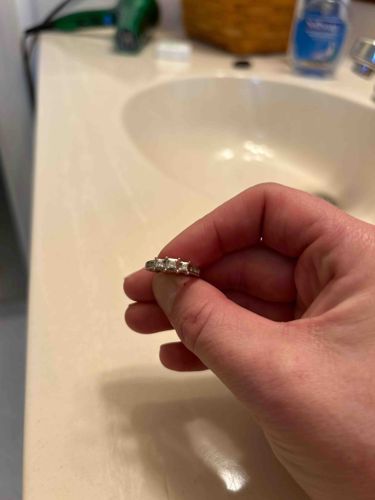
The item is a three-stone ring, likely an anniversary or engagement band, featuring three prominent princess-cut (square-shaped) gemstones set horizontally across the band. The stones appear to be diamonds due to their brilliance and clarity, though a definitive assessment of origin (natural vs. synthetic) and quality (cut, color, clarity, carat) cannot be made from the image alone. Each stone is set in what appears to be a four-prong setting, securely holding it in place. The metal of the band is silver-toned, suggesting it could be white gold, platinum, or sterling silver. The band itself is relatively thin and polished, showcasing a classic and elegant design. There are no visible maker's marks or distinguishing engravings discernible in the image. The ring appears to be in good overall condition, with no obvious signs of major wear, chips, or damage to the stones or the metal band. The surface of the metal shows a high polish, indicating either recent cleaning or well-maintained condition. Based on the design, it appears to be a contemporary piece, likely from the late 20th or early 21st century. The craftsmanship appears to be of good quality, with secure settings and a clean finish. The uniform size and cut of the three stones contribute to a balanced and symmetrical aesthetic, characteristic of classic jewelry designs.
AI Appraisal Report
Based on my visual examination of the provided image, this three-stone princess-cut diamond anniversary ring presents as a classic and elegant piece. The overall condition appears to be very good; the metal shows a high polish, indicative of either recent cleaning or meticulous care, and there are no visible chips, cracks, or significant abrasions on the stones or the band. The four-prong settings for each of the three princess-cut stones appear secure and well-executed, contributing to the ring’s clean finish and good craftsmanship.
From the image, the stones exhibit the brilliance and fire characteristic of diamonds. Their uniform size and cut suggest a cohesive design, likely weighing approximately 0.50 to 0.75 carats each, for a potential total carat weight (TCW) of 1.50 to 2.25 carats. The metal’s silver tone strongly suggests white gold or platinum, with platinum commanding a higher value due to its density and rarity.
In terms of market conditions, three-stone diamond rings remain a highly desirable and classic choice for anniversaries and engagements, ensuring steady demand. The princess cut is also perennially popular, balancing traditional elegance with a contemporary edge. Comparables for similar rings with an estimated 1.50-2.25 TCW of good quality (G-I color, VS-SI clarity) typically range from $2,000 to $5,000, depending heavily on the precise carat weight, color, clarity, and specific metal composition.
However, it is crucial to note the significant limitations of an appraisal based solely on an image. I cannot definitively authenticate the stones as natural diamonds, nor can I ascertain their precise carat weight, color, clarity, or fluorescence. Without in-person examination, it is impossible to distinguish between natural diamonds, lab-grown diamonds, or simulants such as moissanite or cubic zirconia. Furthermore, the exact metal composition (14k white gold, 18k white gold, or platinum) cannot be verified. For a full authentication and a more precise valuation, a physical examination by a GIA Graduate Gemologist is imperative. This would involve a detailed inspection using magnification, precise weighing, spectroscopic analysis, and potentially conductivity testing to confirm the stones' identity and assess their specific 4 Cs (cut, color, clarity, carat weight). Provenance documentation, if available, would also be invaluable, though often not available for pieces of this nature and age.