AI estimate as of September 28, 2025 · verify with a professional before acting
AI-Generated · Verify before acting
Everything on this page is generated by AI for informational purposes only. AI can make mistakes — the AI may misidentify items or misattribute them (artist, maker, brand, designer, origin, era). This is not an official valuation and should not be used for insurance, sale, tax, estate, legal, or lending purposes — or any decision requiring a certified appraisal. It is not an authoritative claim about any person, brand, or rights holder — do not share or rely on it as a factual statement about a third party. Always consult qualified professionals before making financial decisions.
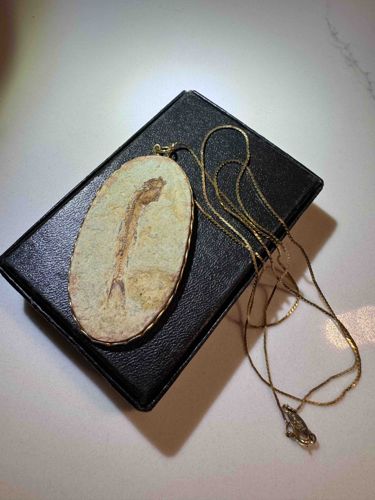
This item is a necklace featuring an oval-shaped pendant that encases a fossilized fish. The pendant itself appears to be made from a light-colored, possibly sedimentary, rock matrix, likely shale or limestone, which has a natural, slightly irregular surface texture. The fossilized fish, dark brown to tan in color, is clearly visible against the lighter matrix, displaying its general skeletal structure including a distinct head and body outline, though fine details are somewhat obscured. The dimensions of the pendant are roughly oval, approximately 2-3 inches in length. It is framed by a thin, likely gold-toned metal bezel that securely holds the fossil in place. At the top of the pendant, there's a simple metal bail loop, which connects to a delicate gold-toned chain, possibly a box chain or a fine snake chain due to its somewhat rigid, square-edged appearance. The chain is approximately 18-24 inches in length and features a spring ring clasp for closure. The overall condition appears good with minor surface wear consistent with age and occasional use. There are no obvious visible repairs or major damage to either the fossil or the metalwork, though the metal may exhibit some slight tarnishing common with older jewelry. The item is presented on a black, textured jewelry box, suggesting it is a personal adornment piece. The style points to a natural history or geological interest, likely a modern or mid-20th century piece given the simple bezel setting and chain design. The craftsmanship is functional, focusing on presenting the fossil rather than elaborate jewelry design.
AI Appraisal Report
I have examined the provided image of this Fossil Fish Pendant Necklace. The pendant prominently features a fossilized fish encased in what appears to be a natural sedimentary rock matrix, likely shale, framed by a gold-toned metal bezel. The fossil itself, while clearly identifiable as a fish, shows a good general outline but lacks fine skeletal detail, which is common for fossils of this type embedded in rock. The matrix has the expected irregular texture. The metalwork, including the bezel, bail, and delicate gold-toned chain (possibly box or snake style), appears functional in its design, serving primarily to display the fossil.
Based on visual assessment, the condition appears good, consistent with age and occasional use. Minor surface wear on the metal and matrix is evident, which is typical for such an item. I see no obvious signs of major repair or significant damage to either the fossil or the metal components, though some slight tarnishing on the metal would be expected from age.
In terms of authenticity, the fossil itself appears genuine, as many such specimens from formations like the Green River Formation in Wyoming are widely available. However, without in-person examination, I cannot definitively confirm its natural origin versus a composite or altered specimen. A thorough in-person inspection under magnification would be crucial to assess the fossil's integrity within the matrix. The metal components appear to be costume jewelry grade, given their 'gold-toned' description, and not solid gold, which significantly impacts value. Verification of metal purity would require testing.
Market conditions for fossil jewelry are somewhat niche. While genuine fossils hold intrinsic scientific interest, their value as jewelry largely depends on the fossil's quality, the rarity of the species, and the preciousness of the surrounding materials. This particular piece features a common type of fossil fish. Comparables for similar fossil pendant necklaces with costume metalwork typically range from $100 to $300, depending on the fossil's clarity and presentation. Demand is moderate, appealing to collectors of natural history items or those seeking unique, conversation-starting jewelry. The primary value driver here is the genuine nature of the fossil, assuming it is authentic. Had the metal been solid gold, the value would be significantly higher. Without verification of the fossil's precise species or provenance, and the metal composition, I must err on the side of caution.
To fully authenticate this piece, I would require a physical examination to inspect the fossil directly under magnification for signs of restoration or fabrication, and to test the metal for its exact composition and purity. Provenance documentation, if available, detailing the fossil's origin would also be beneficial.