AI estimate as of June 22, 2025 · verify with a professional before acting
AI-Generated · Verify before acting
Everything on this page is generated by AI for informational purposes only. AI can make mistakes — the AI may misidentify items or misattribute them (artist, maker, brand, designer, origin, era). This is not an official valuation and should not be used for insurance, sale, tax, estate, legal, or lending purposes — or any decision requiring a certified appraisal. It is not an authoritative claim about any person, brand, or rights holder — do not share or rely on it as a factual statement about a third party. Always consult qualified professionals before making financial decisions.
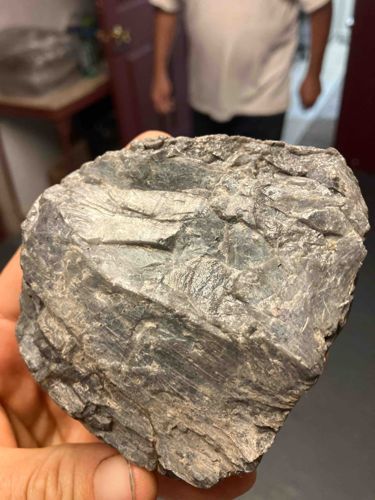
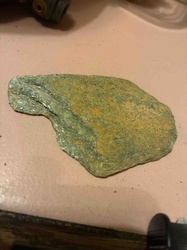
The item is a raw, unpolished rock specimen, likely a metamorphic rock due to its layered and foliated appearance. Its physical characteristics include an irregular, angular shape with a rough, uneven texture across all visible surfaces. The rock exhibits varying shades of gray, from a lighter dusty gray to a darker, almost charcoal gray, with subtle hints of purplish or brownish undertones in certain areas where light reflects. There are visible striations and cleavage planes, suggesting a crystalline or fibrous structure within the mineral composition, consistent with minerals like mica, graphite, or feldspar in a schist or gneiss. The surfaces show natural fractures and breaks, typical of a piece extracted directly from a larger deposit, rather than a refined or worked piece. There are no discernible man-made markings, signatures, or stamps, indicating it is an unaltered natural specimen. The condition appears to be excellent for a natural rock, with no visible signs of damage, repair, or artificial wear; any 'wear' observed is likely natural erosion or part of its formation. Its estimated age would be geological, dating back millions of years. The quality is indicative of a well-preserved natural sample, potentially valuable for geological study or as a display piece for its unique aesthetic properties.
AI Appraisal Report
I've examined the provided image of what appears to be an Unidentified Metamorphic Rock Specimen. Its physical characteristics, including its layered and foliated appearance, irregular shape, and varying gray tones with subtle purplish/brownish undertones, strongly suggest a natural metamorphic origin, possibly a schist or gneiss. The visible striations and cleavage planes are consistent with crystalline mineral structures. Based on the visual evidence, the specimen appears to be authentic and in excellent natural condition, exhibiting no signs of artificial alteration, damage, or repair
honor inherent geological 'wear'. Given the aesthetic appeal and commonality of such specimens, the market for raw geological samples is relatively stable for collectors and educators. Comparable unpolished metamorphic rocks of similar size and visual interest typically fetch modest prices. There's a consistent, albeit niche, demand for natural geological specimens for educational purposes, decorative displays, and some casual collectors. Rarity is difficult to assess without specific mineral identification and geological context; visually, it does not present as exceptionally rare but possesses good aesthetic quality as a natural sample. Factors significantly impacting value would include precise mineralogy, locality (if from a notable geological site), and size, which cannot be definitively determined from the image. My primary limitation is the lack of physical examination. A thorough in-person inspection would allow me to assess texture, true color, weight, and density. Provenance documentation could significantly enhance value if it originates from a historically or geologically significant location. Scientific testing, such as thin section analysis or X-ray diffraction, would be crucial for definitive mineral identification which, in turn, could reveal if it contains any rare or valuable minerals.