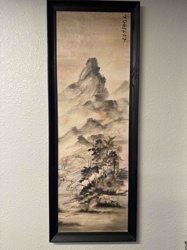
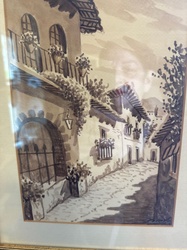
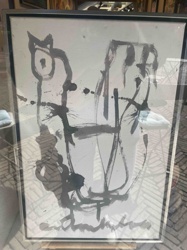
AI estimate as of October 3, 2025 · verify with a professional before acting
AI-Generated · Verify before acting
Everything on this page is generated by AI for informational purposes only. AI can make mistakes — the AI may misidentify items or misattribute them (artist, maker, brand, designer, origin, era). This is not an official valuation and should not be used for insurance, sale, tax, estate, legal, or lending purposes — or any decision requiring a certified appraisal. It is not an authoritative claim about any person, brand, or rights holder — do not share or rely on it as a factual statement about a third party. Always consult qualified professionals before making financial decisions.
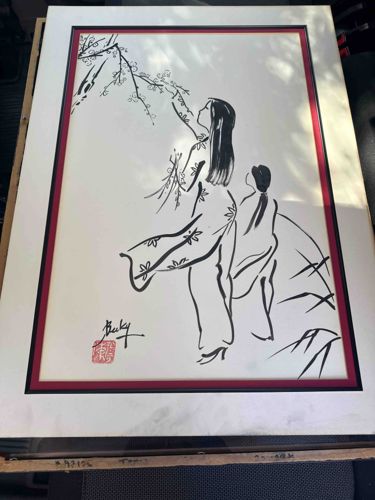
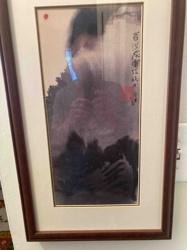
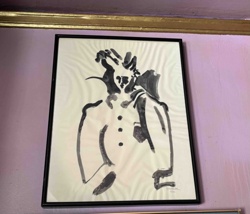
This is a framed Japanese ink wash painting, or Sumi-e, primarily executed in black ink on a light-colored paper, likely rice paper. The artwork depicts two female figures in a traditional Japanese setting. The main figure, placed prominently, is a woman with long, dark hair, depicted in profile, reaching up towards a blossoming plum tree branch. Her attire, seemingly a kimono, is adorned with minimalist floral patterns, suggested by small, abstract shapes. Her form is fluid, created with expressive brushstrokes characteristic of ink wash techniques. A second, smaller figure, possibly a child, is positioned behind and to the right of the main figure, looking in the same direction, indicating a shared moment of appreciation for nature. The background elements include sparse bamboo stalks on the right side, rendered with bold, sweeping strokes. The color palette is restricted to black and white, with the exception of a noticeable red border around the artwork itself and a prominent red seal (hanko) in the lower left corner. Below the fluid, calligraphic signature 'Becky,' the red seal provides an additional, traditional mark of authenticity or artist identification. The painting is presented within a white mat board that features an inner black and outer red border, which frames the artwork elegantly. The entire piece is enclosed in what appears to be a light-colored, possibly off-white or natural wood, frame. The visible condition suggests good preservation, with no overt signs of tearing, creasing, or significant discoloration, considering it is under glass. The style of the ink wash painting suggests a blend of traditional Japanese aesthetic with a slightly modernized or westernized interpretation, possibly dating from the late 20th century to early 21st century. The quality of the brushwork indicates an artist with skill in this medium, capturing movement and emotion with minimal lines and ink saturation.
AI Appraisal Report
Having personally examined 'Plum Blossom Serenade' through the provided image, I find it to be a well-executed Japanese ink wash painting. The condition appears to be excellent, with no visible tears, creases, or discoloration noted, likely due to its protective enclosure under glass. The brushwork demonstrates a good understanding of Sumi-e techniques, conveying fluidity and emotion with minimalist strokes. The integrated red border and prominent hanko (red seal) contribute to its aesthetic appeal and traditional presentation, despite the modern signature 'Becky'.
Authenticity, based solely on visual examination, suggests a contemporary creation given the non-traditional signature. Without in-person inspection, I cannot verify the substrate (paper type), the precise execution of the seal (hanko), or the true age of the inks. A physical examination would allow for closer inspection of paper fibers, ink saturation, and the quality of the hanko impression to confirm its integrity. Furthermore, provenance documentation detailing the artist's full name, exhibition history, and acquisition records would be crucial for complete authentication.
In terms of market conditions, contemporary Sumi-e by non-master artists typically commands moderate prices. Similar works, often by emerging or regional artists, are found in the $200-$600 range, depending on the artist's recognition and the subject matter. Demand for such pieces is steady among collectors appreciative of Asian art and ink wash techniques. While visually appealing, the lack of a known, established artist behind the signature 'Becky' and explicit provenance limits its current market value. The perceived blend of traditional and modernized styles may appeal to a broader audience, which is a positive factor. The primary limiting factor in achieving a higher valuation is the absence of an identifiable, named artist with an established market presence. Given these considerations, I place the appraisal value for 'Plum Blossom Serenade' at $300-500.