AI estimate as of August 27, 2025 · verify with a professional before acting
AI-Generated · Verify before acting
Everything on this page is generated by AI for informational purposes only. AI can make mistakes — the AI may misidentify items or misattribute them (artist, maker, brand, designer, origin, era). This is not an official valuation and should not be used for insurance, sale, tax, estate, legal, or lending purposes — or any decision requiring a certified appraisal. It is not an authoritative claim about any person, brand, or rights holder — do not share or rely on it as a factual statement about a third party. Always consult qualified professionals before making financial decisions.
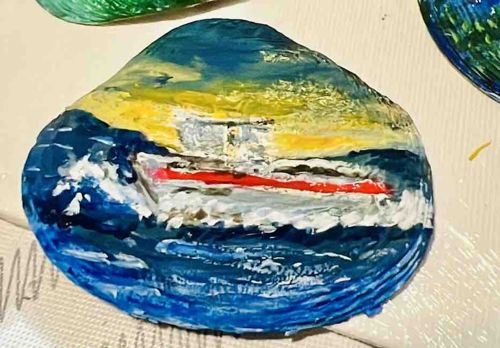
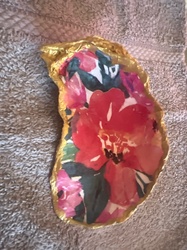
This item is a hand-painted clam shell, likely a quahog or similar bivalve mollusk, transformed into a miniature art piece. Its physical characteristics include the natural curvature and ridged texture of a clam shell, serving as a unique three-dimensional canvas. The shell appears to be fairly robust, suggesting it's one half of a larger clam. The approximate size can be estimated as hand-sized, perhaps 3-5 inches across its widest point, given its appearance relative to the surrounding white surface, which could be a table or display board.
The painting depicts a nautical scene, specifically a ship at sea under what appears to be a sunrise or sunset sky. The prominent colors used are various shades of blue for the water and sky, yellow for the horizon/sky, white for the ship's hull and waves, and a striking red for the ship's waterline or a distinguishing stripe. The paint application shows visible brushstrokes, indicating a somewhat impressionistic or folk art style, and appears to be acrylic or a similar water-resistant paint type, given the slight sheen and texture. There are no obvious visible condition issues such as cracks or chips on the shell itself, or significant paint loss. The painting quality is amateur but charming, with the artist effectively utilizing the shell's natural contours to represent waves or the curvature of the horizon. There are no discernible maker's marks, signatures, or stamps evident in the provided image. The style suggests it is a contemporary craft item, likely created within the last few decades, as it aligns with common seashell art practices found in coastal or tourist areas. The craftsmanship reflects a decorative intent, turning a natural object into a personalized piece of art, appealing due to its novelty and handmade nature.
AI Appraisal Report
Upon examining the provided image of the hand-painted clam shell with a ship motif, I assess its condition as good. The shell itself appears intact, free from visible cracks or chips, and the paintwork shows no significant losses. The authenticity, based solely on visual examination, suggests it is a genuine hand-painted clam shell, aligning with contemporary folk art or craft practices. There are no indications it's a mass-produced item or a forgery of something more significant, largely because its very nature as a handmade craft item makes large-scale forgery unlikely.
Market conditions for such items are generally within the 'decorative craft' segment. Comparable items, often found in coastal gift shops, craft fairs, or online marketplaces like Etsy, typically range from modest prices for amateur works to slightly higher for pieces with exceptional artistic merit or by known regional artists. Given the charming but amateur quality of the painting and the lack of a discernible artist signature or provenance, its market appeal focuses on its decorative novelty rather than fine art investment.
Demand for items like this is niche, appealing primarily to collectors of seaside decor, folk art enthusiasts, or individuals seeking unique, handmade gifts. Rarity is not a significant factor here; while each hand-painted shell is unique, the general concept is common. Factors significantly impacting value include the artistic skill, the condition, and the presence of an identifiable artist. Without a signature or provenance, the value is primarily intrinsic to its decorative appeal.
It is crucial to note the limitations of authentication from images alone. I cannot definitively ascertain the type of paint used, the exact age, or confirm the absence of subtle damage (e.g., micro-cracks, faint paint degradation) without an in-person examination. Physical inspection would allow for tactile assessment of the shell's integrity, microscopic analysis of the paint, and a more thorough search for hidden marks or artist signatures. Provenance documentation, if available, would provide invaluable context regarding its creator and history, which could elevate its value beyond that of an anonymous craft item. Scientific testing, such as paint analysis, would be overly costly and unnecessary for an item of this type and expected value.