These notes were written by the person who submitted this item. Appraiser.AI has not verified them, and the AI's identification and estimate may rely on them.
AI Estimated Value
Not an official valuation
$250-400
AI estimate as of September 7, 2025 · verify with a professional before acting
AI-Generated · Verify before acting
Everything on this page is generated by AI for informational purposes only. AI can make mistakes — the AI may misidentify items or misattribute them (artist, maker, brand, designer, origin, era). This is not an official valuation and should not be used for insurance, sale, tax, estate, legal, or lending purposes — or any decision requiring a certified appraisal. It is not an authoritative claim about any person, brand, or rights holder — do not share or rely on it as a factual statement about a third party. Always consult qualified professionals before making financial decisions.
This analysis also relies on unverified notes provided by the user, which may be incomplete or inaccurate and could affect the result.
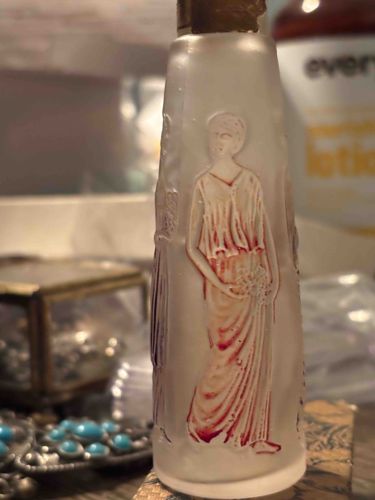
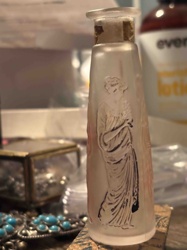
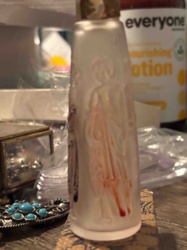
This is a tall, slender perfume bottle crafted from frosted or satin glass, presenting a translucent white appearance. The bottle features raised, bas-relief designs depicting classical figures, specifically a female figure in flowing drapery holding a small bouquet or object. The details of the relief are enhanced with a reddish-pink staining within the recesses, providing stark contrast against the white frosted glass and highlighting the contours of the figures and their garments. The bottle appears to be cylindrical or slightly tapering towards the neck, which is topped with what seems to be a metal stopper, possibly brass or gilded, showing some signs of patina consistent with age. The overall condition is described as good, suggesting minimal chips, cracks, or significant wear to the glass or the applied coloration. The design aesthetic, particularly the classical figures and the frosting technique combined with color enhancement, suggests an Art Nouveau or possibly early Art Deco period influence, likely dating from the late 19th to early 20th century. The craftsmanship is evident in the detailed molding of the figures and the precise application of the color, indicative of a quality manufactured piece designed for a luxury market. The bottle's visible height suggests it's a decorative as well as functional object.
AI Appraisal Report
Based on my visual examination of the provided images, this Art Nouveau frosted glass perfume bottle is in good condition, as stated. The frosted or satin finish appears consistent and undamaged, and the bas-relief classical figures are well-defined. The reddish-pink staining remains largely intact within the recesses, which is crucial for highlighting the Art Nouveau aesthetic and indicative of careful handling over the years. The metal stopper, likely brass, shows appropriate patina for its age, further supporting its authenticity rather than raising concerns.
Market conditions for Art Nouveau glass perfume bottles are generally stable, with demand driven by collectors of decorative arts, perfumeria, and turn-of-the-century items. Comparable pieces by known Art Nouveau glassmakers such as Loetz, Daum, or larger fragrance houses can fetch significantly higher prices. However, without a clear maker's mark or definitive attribution, this piece is valued more as a beautiful decorative object of its period rather than a collectible from a specific high-end artisan.
The rarity of this specific design is moderate; while Art Nouveau perfume bottles are not exceedingly rare, a piece in such good condition with clear classical detailing and original color enhancement is less common. Factors significantly impacting value include the excellent preservation of the frosted glass and the applied color. Its decorative appeal makes it desirable.
My assessment of authenticity is based solely on visual cues. The design, craftsmanship, and apparent age are consistent with the Art Nouveau period (late 19th to early 20th century). However, without direct physical examination, I cannot definitively verify the glass composition, the precise method of frosting, or the application of the reddish stain. An in-person examination would allow for closer inspection for pontil marks, mold lines, and any subtle signs of restoration. Provenance documentation, if available, would significantly enhance authentication and potentially value. Scientific testing, such as spectrometric analysis of the glass or colorant, could provide conclusive proof of age and materials, but this is typically reserved for much higher-value items.