AI estimate as of August 11, 2025 · verify with a professional before acting
AI-Generated · Verify before acting
Everything on this page is generated by AI for informational purposes only. AI can make mistakes — the AI may misidentify items or misattribute them (artist, maker, brand, designer, origin, era). This is not an official valuation and should not be used for insurance, sale, tax, estate, legal, or lending purposes — or any decision requiring a certified appraisal. It is not an authoritative claim about any person, brand, or rights holder — do not share or rely on it as a factual statement about a third party. Always consult qualified professionals before making financial decisions.
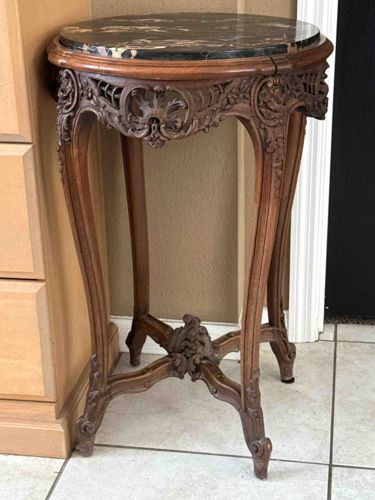
This is an elegant antique or vintage French Rococo Revival style side table, likely crafted from a fine hardwood such as walnut, exhibiting a rich, warm brown tone. The table features a circular top made of black marble with prominent white and possibly light brown or gold veining, offering a luxurious and durable surface. The marble top is snugly fit into a wooden rim, which appears to be part of the table's frame. Below the marble, the frieze and legs are exquisitely carved with intricate Rococo motifs, including acanthus leaves, C-scrolls, and floral elements, showcasing skilled craftsmanship. The four cabriole legs are slender and gracefully curved, terminating in what appear to be scrolled or possibly paw feet, though the very bottom is somewhat obscured. The legs connect to a stretcher base that culminates in a central finial or carving, further enhancing its ornate design. Some sections of the carving, particularly where the legs meet the apron and at the central stretcher, exhibit deep relief and detailed execution, indicating quality construction. The overall condition appears good with a visible patina consistent with age; there might be minor surface wear or slight chipping on the decorative elements, and a visible crack or seam is present in the marble top. The style period strongly suggests a late 19th to early 20th century European origin, specifically emulating the opulence of the Rococo era.
AI Appraisal Report
This French Rococo Revival marble-top side table presents as a charming example of late 19th to early 20th-century European craftsmanship. Based on my visual examination, the overall condition appears good, with a desirable patina consistent with its age. I note the intricate carving, particularly the acanthus leaves, C-scrolls, and floral elements, which are indicative of skilled work. The black marble top with its prominent white and possibly golden veining adds a layer of luxury. However, a significant factor impacting value is the visible crack or seam in the marble top. While the precise nature and extent of this flaw cannot be fully assessed from images, it will undoubtedly necessitate repair or significantly reduce desirability for some buyers.
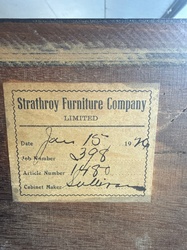
Authenticity, based solely on visual cues, suggests a period-appropriate Rococo Revival piece. The construction and stylistic elements align with common manufacturing practices of that era. However, without a physical examination, I cannot definitively verify the wood type, construction methods (e.g., joinery), or confirm that no modern repairs or significant alterations have occurred. To fully authenticate, I would require in-person inspection to examine joinery, tool marks, and finish, as well as a blacklight examination to detect repairs. Provenance documentation, such as original sales receipts or family histories, would also be invaluable, though often unavailable for pieces of this age.
In terms of market conditions, Rococo Revival furniture maintains a steady, albeit niche, demand. Pieces with elegant designs and quality carving, like this one, are generally sought after by decorators and collectors appreciative of period aesthetics. However, the market is competitive, and condition is paramount. The crack in the marble will significantly impact its marketability and achievable price. Comparables for pieces in excellent condition without major flaws in the marble generally fetch higher prices. Rarity is not exceptionally high for Rococo Revival side tables, but examples with such detailed carving and good overall form are less common than simpler iterations.
Therefore, considering the visible flaw in the marble, which is the primary factor driving down the value, my appraisal reflects a piece needing some attention or one that will appeal to a buyer willing to overlook the flaw for its inherent charm and decorative appeal.