AI Appraisal Estimate

AI-generated estimates · not official valuations

From the user

What was submitted

Photo and notes provided by the user — not generated by AI

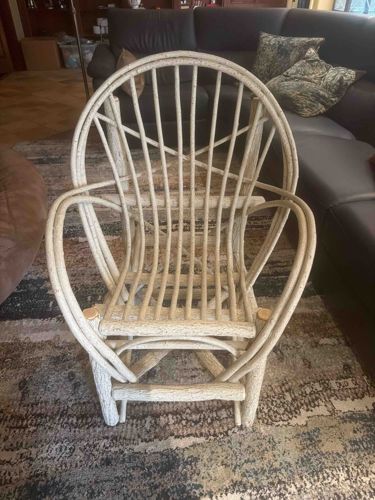
Submitted item photo
Submitted photo · June 4, 2026

User's notes

No additional notes provided.

AI analysis below

AI appraisal

AI analysis & estimate

AI-Generated · Verify before acting

Everything below is generated by AI for informational purposes only. AI can make mistakes — the AI may misidentify items or misattribute them (artist, maker, brand, designer, origin, era). This is not an official valuation and should not be used for insurance, sale, tax, estate, legal, or lending purposes — or any decision requiring a certified appraisal. It is not an authoritative claim about any person, brand, or rights holder — do not share or rely on it as a factual statement about a third party. Always consult qualified professionals before making financial decisions.

Read the full disclaimer

AI Identification

·Not independently authenticated·Verify before acting

Vintage Bent Hickory Willow Hoop-Back Armchair

Furniture / Rustic Antiques

AI Estimated Value

·Not an official valuation·Verify before acting

$350.00 - $600.00

As of June 4, 2026

AI Item Analysis

·AI can make mistakes·Verify before acting
This is a classic example of American rustic furniture, specifically a 'hoop-back' armchair crafted from bentwood materials, likely willow or hickory saplings. The chair features a distinctive curvilinear design characterized by a large outer oval loop that forms the backrest and structure. Within this frame, vertical spindles fan out to create the seat and back support, joined at the base and curving upward. The wide, looped armrests are integrated into the frame, providing both structural stability and an organic aesthetic. The wood retains its natural bark, exhibiting a textured, light-colored 'driftwood' or weathered finish that suggests it may have been finished with a light whitewash or simply aged naturally. The construction utilizes interlocking bent saplings secured with small nails or tacks, a hallmark of traditional Appalachian or Lodge-style craftsmanship. This piece likely dates from the mid-to-late 20th century, though it follows a design tradition popular since the late 19th century. Condition-wise, the chair appears structurally intact with some visible darkening and minor abrasions consistent with age. There are no immediate signs of significant splintering or broken rungs, though the organic nature of the materials means natural warping is present. The craftsmanship displays high-quality hand-manipulation of the wood to achieve the dramatic symmetrical curves without snapping the fibers.
AI Appraisal Report

·AI can make mistakes·Verify before acting
I have virtually examined this vintage bentwood armchair, which represents a classic example of Appalachian-style rustic furniture. The piece demonstrates high-level craftsmanship, utilizing the natural elasticity of hickory or willow saplings to achieve complex hoop-back and fan-spindle geometry. The construction uses authentic joinery techniques involving bentwood tension and small-gauge fasteners, consistent with mid-to-late 20th-century artisanal production. The weathered, whitewashed finish appears largely original, though it shows expected oxidation and surface abrasions that certify its age without compromising structural integrity. Historically, these pieces are highly sought after for Lodge and Cabin-style interior design. Market demand for authentic rustic seating remains steady, with similar hoop-back designs fetching between $300 and $700 at regional specialty auctions. The value is buoyed by the symmetry of the fan-back, which is difficult to execute without snapping the sapling fibers. However, high-quality contemporary reproductions can mimic this style, making definitive dating difficult. Limitations: My assessment is based solely on visual analysis of the images. A physical inspection is required to check for structural 'racking' (loose joints), hidden wood-boring insect damage, or identification of modern pneumatic staples which would indicate mass production rather than hand-craftsmanship. Full authentication would require provenance documentation or a maker's mark, often found charred into the underside of the seat frame or on a small metal tag. Without physical tactile testing of the wood's moisture content and nail patination, I cannot rule out a late-contemporary replica.

Get your items appraised

Instant estimates of your treasures with AI-powered appraisals

Browse More Appraisals