These notes were written by the person who submitted this item. Appraiser.AI has not verified them, and the AI's identification and estimate may rely on them.
AI Estimated Value
Not an official valuation
$350 - $550
AI estimate as of August 2, 2025 · verify with a professional before acting
AI-Generated · Verify before acting
Everything on this page is generated by AI for informational purposes only. AI can make mistakes — the AI may misidentify items or misattribute them (artist, maker, brand, designer, origin, era). This is not an official valuation and should not be used for insurance, sale, tax, estate, legal, or lending purposes — or any decision requiring a certified appraisal. It is not an authoritative claim about any person, brand, or rights holder — do not share or rely on it as a factual statement about a third party. Always consult qualified professionals before making financial decisions.
This analysis also relies on unverified notes provided by the user, which may be incomplete or inaccurate and could affect the result.
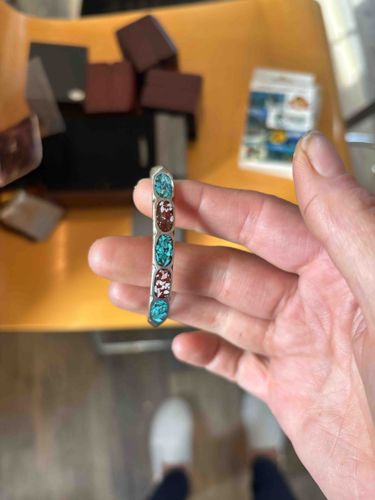
This is a vintage cuff bracelet, likely made from sterling silver, featuring a unique mosaic or inlay design. The bracelet is open on one side, typical of a cuff style, and appears to be of a medium width. The main decorative element consists of a series of approximately five oval-shaped cabochons, set in a linear fashion along the top surface of the bracelet. Each oval inlay showcases a different material, displaying a vibrant palette of colors and textures. The visible inlays include a dominant turquoise-like blue-green material, displaying natural matrix patterns, and at least two other distinct materials. One of these appears to be a reddish-brown stone, possibly spiny oyster, jasper, or another type of natural rock, with lighter inclusions or veining. Another inlay, seemingly in the middle, presents a mottled white and reddish-brown pattern, suggestive of a different type of shell or stone. The stones are carefully cut and set flush into the metal, indicating a precise inlay technique. The silver work encasing these stones appears to be simple and robust, suggesting a handcrafted piece. The overall construction exhibits solid craftsmanship, with no visible signs of loose stones or significant damage. There might be minor surface wear and a slight patina consistent with age and use, which would add to its vintage appeal. The style is reminiscent of Southwestern Native American jewelry, particularly Zuni or Navajo inlay work, which would place its estimated age in the mid to late 20th century. The mention of an 'identification number on the back' suggests the presence of a maker's mark, artist's signature, or a cataloging number, which would be crucial for further identification and appraisal. The quality of the stone cutting and the secure setting attest to a skilled artisan.
AI Appraisal Report
Upon examining the provided images and description of this Southwestern inlay cuff bracelet, I assess it to be a well-crafted, vintage piece, likely dating from the mid to late 20th century. The quality of the stone-to-stone inlay work, featuring what appears to be turquoise, spiny oyster, and potentially other materials set in sterling silver, suggests a skilled Zuni or Navajo artisan. The overall condition appears to be very good, with minor surface wear and a light patina consistent with its age, which does not detract from its value. The presence of an identification number on the back is a significant factor. If this mark corresponds to a known or collectible artist, the value could increase substantially. My valuation is based on current market trends for similar, unsigned vintage Southwestern inlay cuff bracelets. The demand for authentic, handcrafted Native American jewelry remains strong. However, without a physical examination, I cannot definitively authenticate the materials (e.g., test the silver purity, confirm the types of stone and shell) or verify the maker's mark. Full authentication would require an in-person inspection to test the metal and stones, as well as research to identify the 'identification number' and attribute it to a specific artist. Provenance or documentation of purchase would also strengthen its value and authenticity.