AI estimate as of August 7, 2025 · verify with a professional before acting
AI-Generated · Verify before acting
Everything on this page is generated by AI for informational purposes only. AI can make mistakes — the AI may misidentify items or misattribute them (artist, maker, brand, designer, origin, era). This is not an official valuation and should not be used for insurance, sale, tax, estate, legal, or lending purposes — or any decision requiring a certified appraisal. It is not an authoritative claim about any person, brand, or rights holder — do not share or rely on it as a factual statement about a third party. Always consult qualified professionals before making financial decisions.
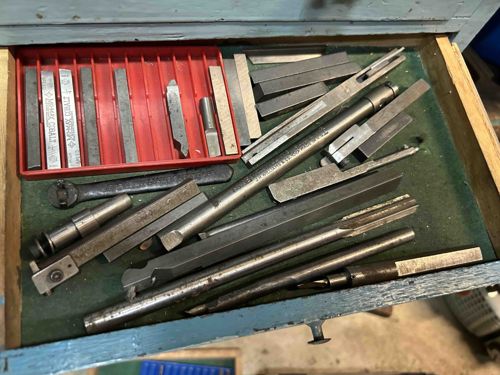
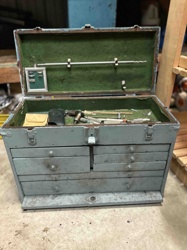
This appears to be a drawer full of various metalworking tools, primarily cutting tools and accessories used in machining operations, likely for lathes or milling machines. The collection includes a red plastic organizer tray containing several small, rectangular cutting bits, some of which are marked 'MOHAWK COBALT', indicating their material composition and intended use for machining hard metals. There are also numerous larger, elongated metal tools with various cutting profiles and shank types, including what appear to be reamers, boring bars, and possibly specialized lathe bits. One visible tool has a knurled section and a slotted end, typical of a boring bar or a tool holder. Another seems to be a tap or reamer with fluted cutting edges. A small, black-handled wrench is also present. The tools exhibit varying degrees of wear, with some showing typical signs of use like scratches, discoloration, and minor surface oxidation (patina) consistent with ferrous metals. The overall condition suggests they are used, but still functional. Many of the tools have a dark, untreated metal finish, characteristic of high-speed steel or cobalt alloys. The drawer itself appears to be made of wood, painted light blue, with a green felt or fabric lining at the bottom, which is stained and worn in areas, further suggesting age and prolonged use. The assortment indicates a well-used set of tools belonging to a machinist or hobbyist, likely from the mid to late 20th century.
AI Appraisal Report
I have examined the provided image of the 'Assorted Machinist's Lathe and Milling Tools in Drawer' and offer the following appraisal. Based on my visual inspection, the tools appear to be authentic machinist's tools, consistent with typical tooling found in workshops. The 'MOHAWK COBALT' markings on some cutting bits provide a strong indication of their material and purpose, supporting authenticity. The overall condition shows considerable use, as evidenced by scratches, discoloration, and minor surface oxidation. This wear is expected for functional shop tools and does not necessarily detract from their utility, though it impacts their collectible appeal. The blue painted wooden drawer with a worn felt lining further suggests a working environment and age, likely mid to late 20th century.
In terms of market conditions, individual used machinist tools generally hold value, especially well-known brands or specialized items. However, their collective value is often less than if sold individually, unless they form a highly curated or complete set, which this does not appear to be. Comparables would include lots of used tooling sold at auction or through online marketplaces like eBay or specialized industrial surplus dealers. Demand for such tools remains steady among hobbyists, small machine shops, and educational institutions. Rarity is low; these are common industrial tools, not rare collectibles. Factors significantly impacting value include the type and brand of specific tools (e.g., reamers, boring bars), the integrity of their cutting edges, and the presence of any unique or custom-made items. The 'MOHAWK COBALT' bits are a clear value add.
My assessment of authenticity is based solely on visual cues from the image. Without a physical examination, I cannot definitively confirm the material composition of all tools, the sharpness or integrity of cutting edges, or the absence of hidden damage. A hands-on inspection would allow for testing of specific tool dimensions, assessing internal wear in the case of reamers or taps, and verifying material hardness. Provenance documentation (e.g., original purchase receipts, owner history) would enhance authentication, but is rarely available for such practical items. Scientific testing (e.g., material analysis) is not typically performed or necessary for this type of item given its market.