AI estimate as of October 6, 2025 · verify with a professional before acting
AI-Generated · Verify before acting
Everything on this page is generated by AI for informational purposes only. AI can make mistakes — the AI may misidentify items or misattribute them (artist, maker, brand, designer, origin, era). This is not an official valuation and should not be used for insurance, sale, tax, estate, legal, or lending purposes — or any decision requiring a certified appraisal. It is not an authoritative claim about any person, brand, or rights holder — do not share or rely on it as a factual statement about a third party. Always consult qualified professionals before making financial decisions.
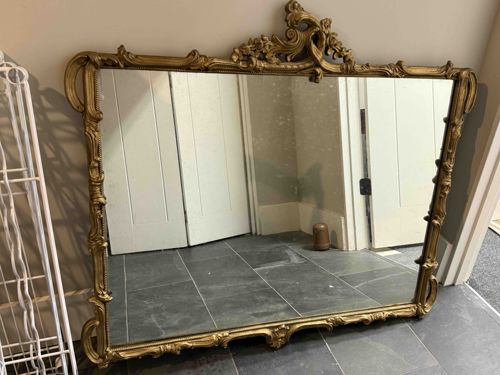
This is a large, rectangular wall mirror featuring an elaborately carved giltwood frame in a Rococo Revival style. The frame is finished with a rich, antique gold patination, showcasing intricate scrollwork, acanthus leaves, and floral motifs throughout. The top center of the frame is adorned with a prominent cartouche-like crest, featuring a central shell-like form surrounded by further scrolling details and delicate floral garlands, indicative of classic Rococo design principles emphasizing asymmetry and organic curves. The sides of the frame are characterized by deeply carved decorative elements, including reeded sections, foliate details, and stylized elongated scrolls that extend down the vertical sides and around the bottom corners. The bottom edge of the frame also showcases similar curvilinear and shell-inspired carvings. The mirror plate itself appears to be clear and unframed within the giltwood, reflecting its surroundings. There are some visible condition issues on the mirror surface, specifically several smudges or marks, possibly dust or minor silvering degradation, particularly in the upper left quadrant. The gilt finish on the frame shows signs of age-appropriate wear, with some minor rubs or areas where the gilding might be slightly dulled, contributing to its antique aesthetic. The substantial size and detailed carving suggest a high-quality piece, likely intended as a focal point in a formal living space or entryway. Based on the ornate styling and construction, it is estimated to be from the late 19th to early 20th century. There are no visible maker's marks or signatures readily apparent in the image.
AI Appraisal Report
Based on my visual examination of the provided image, this is a substantial Giltwood Rococo Revival Wall Mirror, likely dating from the late 19th to early 20th century. The elaborate carving, featuring intricate scrollwork, acanthus leaves, floral motifs, and a prominent cartouche crest, is characteristic of the Rococo Revival style, emphasizing organic curves and asymmetry. The size and detailed execution suggest it was a focal point in a formal setting. Condition-wise, the gilt finish shows age-appropriate wear, contributing to its antique aesthetic. Some minor rubs or dulling of the gilding are present, which is expected for a piece of this age and generally does not significantly detract from value unless severe. The mirror plate itself appears clear but shows several smudges or marks, particularly in the upper left quadrant, which could be dust or minor silvering degradation. While the latter would require professional re-silvering, smudges are easily cleaned. Without physical inspection, it is impossible to definitively determine the extent of these mirror plate issues or the exact nature of the giltwood's patination and any potential repairs. Similarly, authenticity regarding the period of manufacture is based on stylistic cues alone; an in-person examination could confirm wood species, construction techniques, and joinery, which are crucial for full authentication. Market demand for well-preserved, ornate Rococo Revival mirrors remains moderate, especially for larger, more impressive examples. Comparables of similar quality and size typically trade in the $2,000-$4,000 range, though condition heavily influences the final sale price. The lack of visible maker's marks is common for this type of item from this period. Considering the visual evidence, I estimate its value to be in the range of $1,800 - $2,800. A more precise valuation would necessitate a hands-on assessment to verify condition nuances, construction details, and the material integrity of both the frame and the mirror plate.