AI estimate as of July 12, 2025 · verify with a professional before acting
AI-Generated · Verify before acting
Everything on this page is generated by AI for informational purposes only. AI can make mistakes — the AI may misidentify items or misattribute them (artist, maker, brand, designer, origin, era). This is not an official valuation and should not be used for insurance, sale, tax, estate, legal, or lending purposes — or any decision requiring a certified appraisal. It is not an authoritative claim about any person, brand, or rights holder — do not share or rely on it as a factual statement about a third party. Always consult qualified professionals before making financial decisions.
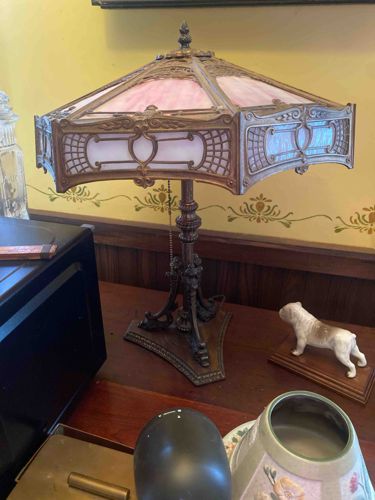
This is an antique or vintage table lamp, likely dating from the early 20th century, possibly in the Arts and Crafts or Art Nouveau style. The lamp features a multifaceted, hexagonal shade constructed from metal leading and various types of art glass. The top panels of the shade appear to be made of a translucent, mottled pink or rose-colored glass, while the side panels alternate between plain white or cream-colored sections and sections that reveal iridized or 'peacock' glass, exhibiting shifts in color when viewed from different angles. The metal leading on the shade is highly decorative, featuring intricate filigree work, lattice patterns, organic scrollwork, and geometric motifs, with a patinated bronze or brass finish that suggests age and adds to its antique aesthetic. The lamp's base is substantial and appears to be made of cast metal, possibly iron or bronze, finished to match the shade's leading. It features a decorative columnar shaft with ornate detailing, resting on a sturdy, splayed multi-footed base, which also incorporates decorative elements that complement the shade's design. A pull chain switch for operation is visible, consistent with lamps of this period. There are no obvious signs of significant damage like major cracks in the glass or large bends in the metal, but typical wear and tear appropriate for its age, such as minor scuffs, dust accumulation, and a consistent patina, are present. The craftsmanship appears to be of good quality, with well-executed lead work and detailed casting on the base, indicative of a manufactured piece designed for aesthetic appeal and functionality.
AI Appraisal Report
Upon visual examination of the provided image, this Arts and Crafts/Art Nouveau style table lamp presents as an authentic piece from the early 20th century. The intricate filigree, lattice work, and organic scrollwork on the shade's leading, combined with the substantial, ornate cast metal base, are highly consistent with designs from this period. The use of mottled pink art glass and what appears to be iridized ('peacock') glass sections further supports its authenticity and period style.
The condition appears good for its age, showing typical wear like consistent patina and minor scuffs, but no obvious significant damage such as cracks in the glass or major metal distortions. This indicates careful handling over time. The craftsmanship, particularly the detailed lead work and base casting, is of good quality, suggesting a well-made manufactured piece rather than a studio craft item.
In terms of market conditions, period lamps of this style with art glass shades are consistently in demand, especially those with unique glass combinations and well-preserved metalwork. Comparables in the current market for well-preserved Arts and Crafts or Art Nouveau table lamps of similar scale and complexity often fetch between $1,500 and $3,500, depending on maker attribution and specific design elements. The 'peacock' glass is a desirable feature that enhances its appeal.
Factors significantly impacting value include the overall aesthetic appeal, condition, provenance (if available), and potential attribution to a specific workshop or designer (e.g., Tiffany Studios, Handel, Pairpoint), though no distinctive maker's marks are visible in the image. Rarity is moderate; while many lamps were produced, one in this condition with varied art glass is less common.
It is crucial to note that this appraisal is based solely on visual evidence from the image. Full authentication would require in-person examination to verify glass types, confirm material composition of the base, check for signatures or maker's marks, and assess the integrity of all solder joints and the electrical components for safety. Provenance documentation (e.g., original sales receipts, family history) would further solidify authenticity and potentially increase value. Scientific testing of materials (e.g., XRF for metal composition) could confirm age and origin definitively.