AI estimate as of September 5, 2025 · verify with a professional before acting
AI-Generated · Verify before acting
Everything on this page is generated by AI for informational purposes only. AI can make mistakes — the AI may misidentify items or misattribute them (artist, maker, brand, designer, origin, era). This is not an official valuation and should not be used for insurance, sale, tax, estate, legal, or lending purposes — or any decision requiring a certified appraisal. It is not an authoritative claim about any person, brand, or rights holder — do not share or rely on it as a factual statement about a third party. Always consult qualified professionals before making financial decisions.
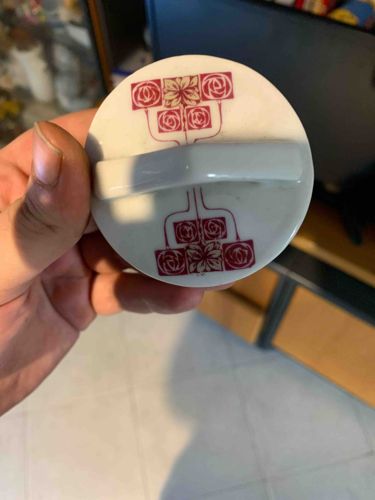
This appears to be a ceramic lid, likely for a sugar bowl, teapot, or casserole dish, given its circular shape and integrated handle. The lid is predominantly white or off-white, made of glazed ceramic or porcelain. The glazes show a subtle sheen, indicating good quality finishing. The design prominently features a stylized floral pattern in a deep red or maroon color, possibly with darker outlines, applied as a decal or transfer print. The pattern consists of abstract roses or flower motifs enclosed within square frames. These squares are arranged in a symmetrical pattern, with groups of four squares at the top and bottom of the lid, connected by thinner lines, creating a somewhat geometric and botanical aesthetic. One of the top squares has a slightly different pattern, possibly indicating a variant in the design or a deliberate accent. The integrated handle is a bar-shaped protrusion, approximately 2-3 inches long, aligned with the radial center of the lid, providing a functional grip. The condition appears to be relatively good, with no overt chips, cracks, or significant crazing visible from the provided image, though there is a slight discoloration or fading/wear on one of the floral squares at the top, suggesting age or use. The style period is difficult to ascertain precisely without further context, but the stylized floral pattern could place it anywhere from the mid-20th century to a more contemporary, retro-inspired piece. The craftsmanship appears mass-produced rather than handcrafted, typical of everyday ceramic ware. There are no visible maker's marks or signatures.
AI Appraisal Report
Upon visual examination of this white ceramic lid, I assess its condition as good, noting the subtle sheen of the glaze indicating good quality finishing. There are no overt chips, cracks, or significant crazing visible, which is positive for its value. However, I observe some discoloration or wear on one of the floral squares, consistent with age or use. Authenticity, based solely on this image, appears to be that of a mass-produced item. The stylized red floral pattern within square frames, while aesthetically pleasing, suggests a decal or transfer print technique common in mid-20th century to contemporary retro-inspired ceramic ware. Without physical inspection, I cannot confirm the exact manufacturing process or material composition beyond 'glazed ceramic/porcelain'.
Market conditions for standalone ceramic lids, especially without the accompanying vessel, are generally low unless they belong to a highly collectible or rare set from a prominent manufacturer. Comparable items of mass-produced, vintage ceramic lids with similar decorative attributes typically retail in the $10-$40 range, often as replacement parts or for decorative purposes. Demand for such an item is limited, primarily to individuals seeking a replacement for a specific missing piece or collectors of a very niche aesthetic. Its rarity is low, given its likely mass-produced nature. The absence of maker's marks or signatures significantly impacts its value, preventing attribution to a known brand that could elevate its market appeal.
Key factors limiting its value are its status as a single lid (not part of a complete set or item), lack of identifying marks, and common manufacturing style. For full authentication and a more precise valuation, an in-person examination would be crucial to assess the true condition, material quality, and search for subtle maker's marks. Provenance documentation, if available, could also provide valuable context, and scientific testing could confirm material composition or age more definitively.