AI Appraisal Estimate

AI-generated estimates · not official valuations

From the user

What was submitted

Photo and notes provided by the user — not generated by AI

Submitted item photo
Submitted photo · June 10, 2026

User's notes

No additional notes provided.

AI analysis below

AI appraisal

AI analysis & estimate

AI-Generated · Verify before acting

Everything below is generated by AI for informational purposes only. AI can make mistakes — the AI may misidentify items or misattribute them (artist, maker, brand, designer, origin, era). This is not an official valuation and should not be used for insurance, sale, tax, estate, legal, or lending purposes — or any decision requiring a certified appraisal. It is not an authoritative claim about any person, brand, or rights holder — do not share or rely on it as a factual statement about a third party. Always consult qualified professionals before making financial decisions.

Read the full disclaimer

AI Identification

·Not independently authenticated·Verify before acting

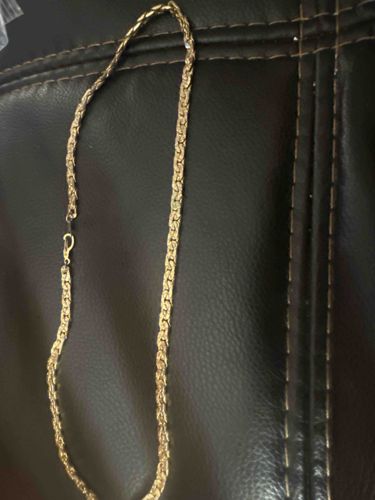
Gold-Tone Byzantine Chain Necklace

Jewelry

AI Estimated Value

·Not an official valuation·Verify before acting

$50 - $150

As of June 10, 2026

AI Item Analysis

·AI can make mistakes·Verify before acting
This item is a gold-tone chain necklace, characterized by its intricate Byzantine weave pattern. The chain appears to be constructed from a series of interconnected, interlocking links that create a dense, flexible, and visually rich texture. The color is a consistent light gold, suggesting it might be gold-plated base metal or a lower karat gold alloy, although without more information on hallmarks or material testing, a definitive determination cannot be made from the image alone. The chain has a noticeable heft and substance due to the tightly woven links. It features a simple lobster claw clasp, visible at one end of the chain, which is a common and secure fastening mechanism for necklaces of this type. The links themselves exhibit a slightly flattened, rectangular appearance when viewed closely, forming the characteristic square-like profile of a Byzantine chain. There are no readily apparent maker's marks or signatures visible in the provided images. The overall condition appears to be good with a consistent color across the visible length, though some minor surface wear or tarnish, typical of used jewelry, might be present upon closer physical inspection. The craftsmanship appears competent, with uniform link formation suggesting machine-made production, common for this style of chain. Its style suggests it could be from a contemporary period, likely late 20th century or early 21st century.
AI Appraisal Report

·AI can make mistakes·Verify before acting
Based on my visual examination of the provided image, this item is a gold-tone Byzantine chain necklace. The intricate Byzantine weave is well-executed, creating a dense and flexible texture. The consistent light gold color suggests it is likely gold-plated or a lower karat gold alloy, rather than solid high-karat gold. The presence of a standard lobster claw clasp further supports this, as higher-end solid gold pieces often feature more elaborate or custom clasps. The condition appears good, with no obvious damage or significant wear visible, though I note that minor surface wear or tarnish would require a physical inspection to confirm. The uniform link formation indicates machine production, typical for this style. Its aesthetic places it in a contemporary period, likely late 20th or early 21st century. Market conditions for gold-tone costume jewelry or lower karat gold chains of this style are stable but not high-value. Comparables in the secondary market for similar well-made, gold-plated Byzantine chains typically range from $40 to $100 depending on length and condition. If it were determined to be a low karat gold (e.g., 9K or 10K), the value would increase, but still be modest due to gold content and weight. Demand is moderate, as Byzantine chains are a classic but not exceptionally rare style. Factors impacting value significantly would be material composition and brand. Without clear hallmarks or material testing, authenticity verification is limited. A definitive determination of its gold content (plated vs. solid gold, and karat purity if solid) would require an in-person examination, specific gravity testing, or acid testing. Additionally, the presence or absence of maker's marks, which are not visible in the image, could further inform authenticity and value.

Get your items appraised

Instant estimates of your treasures with AI-powered appraisals

Browse More Appraisals