AI Appraisal Estimate

AI-generated estimates · not official valuations

From the user

What was submitted

Photo and notes provided by the user — not generated by AI

Submitted item photo
Submitted photo · May 19, 2026

User's notes

No additional notes provided.

AI analysis below

AI appraisal

AI analysis & estimate

AI-Generated · Verify before acting

Everything below is generated by AI for informational purposes only. AI can make mistakes — the AI may misidentify items or misattribute them (artist, maker, brand, designer, origin, era). This is not an official valuation and should not be used for insurance, sale, tax, estate, legal, or lending purposes — or any decision requiring a certified appraisal. It is not an authoritative claim about any person, brand, or rights holder — do not share or rely on it as a factual statement about a third party. Always consult qualified professionals before making financial decisions.

Read the full disclaimer

AI Identification

·Not independently authenticated·Verify before acting

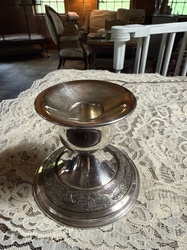
Japanese Export Silver Dragon Bowl

Asian Antiques / Silver Tableware

AI Estimated Value

·Not an official valuation·Verify before acting

$4,500 - $6,500

As of May 19, 2026

AI Item Analysis

·AI can make mistakes·Verify before acting
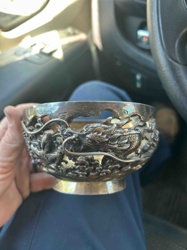
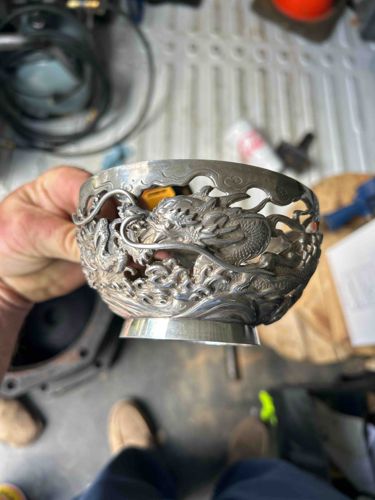
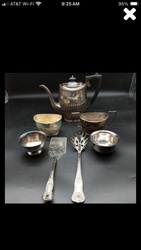
This is a detailed Japanese export silver bowl, likely dating from the Meiji period (late 19th to early 20th century). The bowl features a classic 'Japanese Dragon' design in high-relief repoussé work. The dragon's body intricately wraps around the circumference of the vessel amidst swirling clouds and stylized waves. A distinctive feature is the pierced openwork or reticulated construction, where parts of the background are cut away to create a three-dimensional effect between the dragon and the inner liner (which appears to be missing or integrated). The metal exhibits the characteristic greyish-white luster of high-grade silver, though there is significant tarnish and dark patina in the recessed areas, which helps highlight the detail of the scales, whiskers, and claws. The bowl sits on a plain, slightly flared circular foot ring. While no specific maker's marks are visible in the photo, this style is synonymous with workshops in Yokohama such as those of Kuhn & Komor or Samurai Shokai. The condition shows some minor surface abrasions and signs of handling, but the structural integrity of the complex chasing appears sound. The craftsmanship is of high quality, indicative of the skilled metalworking traditional to the Meiji era intended for the Western market.
AI Appraisal Report

·AI can make mistakes·Verify before acting
Based on my visual examination of the provided imagery, I have assessed this Japanese export silver bowl featuring high-relief repoussé dragon motifs. The craftsmanship is exemplary of the Meiji Period (1868-1912), specifically adhering to the style of the 'Yokohama' workshops. The bowl demonstrates the high-quality 'double-walled' construction technique, where the outer pierced reticulated shell creates a dramatic sense of depth against the inner vessel. The density of the chasing and the anatomical precision of the three-clawed dragon suggest a master-level silversmithing hand. The market for Meiji-era export silver remains robust, with collectors actively seeking large-form dragon bowls. Recent auction results for signed works by established makers like Kuhn & Komor or Miyamoto Shoko suggest similar pieces fetch significant premiums. The current condition shows a desirable dark patina which enhances the textural details, though the apparent absence of a secondary glass or silver liner—common in some forms—must be considered. Limitations: My assessment is based solely on digital images. A definitive valuation is contingent upon a physical inspection to verify the purity of the silver and the presence of hidden hallmarks (often found under the foot rim or within the dragon's scales). Digital images cannot confirm the total weight in troy ounces, which fundamentally anchors the base value. To finalize this appraisal, I would require an in-person examination to check for structural stress fractures in the reticulated areas, a precise weight, and provenance documentation. Weight and maker identification remain the primary variables that could push this valuation into the five-figure range or reduce it if the metal is found to be silver-plated white metal.

Get your items appraised

Instant estimates of your treasures with AI-powered appraisals

Browse More Appraisals