AI estimate as of October 31, 2025 · verify with a professional before acting
AI-Generated · Verify before acting
Everything on this page is generated by AI for informational purposes only. AI can make mistakes — the AI may misidentify items or misattribute them (artist, maker, brand, designer, origin, era). This is not an official valuation and should not be used for insurance, sale, tax, estate, legal, or lending purposes — or any decision requiring a certified appraisal. It is not an authoritative claim about any person, brand, or rights holder — do not share or rely on it as a factual statement about a third party. Always consult qualified professionals before making financial decisions.
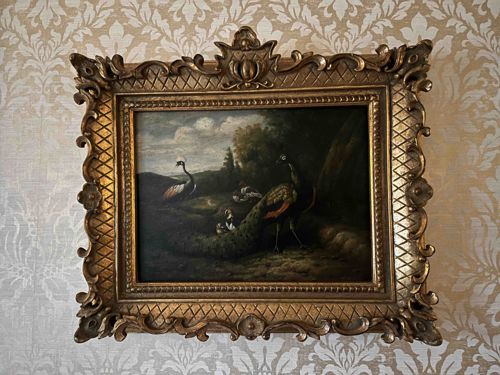
This item is an oil painting depicting peacocks and peahens within a verdant landscape setting, housed in a highly ornate giltwood frame. The painting itself features a dark, somewhat moody palette with dominant greens, browns, and blues for the foliage, ground, and sky, respectively. Two prominent peacocks or peahens are visible in the foreground and mid-ground; one on the left appears to be in repose near a body of water, while another on the right stands full-figured, displaying its characteristic plumage, though not fully fanned. Smaller, possibly juvenile birds, are clustered near the rightmost bird. The background includes dense trees and a cloudy sky. The overall impression of the painting is that of a classical or perhaps academic style, with attention to naturalistic detail. The frame is a particularly notable feature, crafted from what appears to be carved and gilded wood. Its design is intricate, characterized by elaborate rococo-style scrolling foliage, C-scrolls, and shell motifs, concentrated especially at the corners and the top center, where a crown-like crest is present. A repeating textured or cross-hatch pattern runs along the inner edge of the frame, bordering the painting. The gilding exhibits a rich, aged gold color, suggesting either genuine gold leaf with a patinated finish or a high-quality metallic paint. There are some visible signs of wear and tear on the frame, including minor chips or abrasions to the gilding, particularly on the raised decorative elements, which is common for an item of likely significant age. The painting itself appears to be in good condition, with no obvious major cracks, paint loss, or repairs visible from the provided image, though a closer inspection would be required to confirm. The style and craftsmanship of the frame suggest a period between the late 19th and early 20th centuries, possibly as an antique reproduction or a period piece. The quality of both the painting and the frame indicates a well-executed piece of decorative art.
AI Appraisal Report
Upon visual examination of the provided image, I assess this oil painting of peacocks in a landscape, housed in its ornate giltwood frame, to be a well-executed decorative piece. The painting itself appears to be in good condition, showing no conspicuous signs of major damage such as cracks, significant paint loss, or repairs. The dark, academic style with naturalistic detail suggests a late 19th to early 20th-century aesthetic. The frame is a significant value contributor; its elaborate rococo-style carving, intricate motifs, and rich, aged gilding indicate quality craftsmanship and likely commensurate age. Visible wear, such as minor chips to the gilding, is consistent with its probable age and use.
Market conditions for detailed animal paintings, especially those with strong decorative appeal, remain stable. The period-appropriate, ornate frame enhances its marketability considerably, as these frames are often sought after independently. Demand for classical-style wildlife art, particularly with exotic birds, is consistent among collectors and interior designers. While this is not a rare subject, the quality of execution in both painting and frame elevates its desirability.
Factors impacting value positively include the overall aesthetic appeal, the apparent good condition of the artwork, and the exceptional quality and condition of the frame. Limitations in authenticity verification from an image alone are significant. Without physical examination, I cannot definitively confirm the medium (e.g., true oil on canvas vs. print on canvas), the surface condition beyond what is visible, or the structural integrity of the frame. To fully authenticate and confirm the artist (if signed), provenance documentation would be essential. An in-person inspection would also allow for examination under UV light to detect restorations or overpainting, and a thorough assessment of the frame's construction, gilding technique, and materials.