AI estimate as of October 19, 2025 · verify with a professional before acting
AI-Generated · Verify before acting
Everything on this page is generated by AI for informational purposes only. AI can make mistakes — the AI may misidentify items or misattribute them (artist, maker, brand, designer, origin, era). This is not an official valuation and should not be used for insurance, sale, tax, estate, legal, or lending purposes — or any decision requiring a certified appraisal. It is not an authoritative claim about any person, brand, or rights holder — do not share or rely on it as a factual statement about a third party. Always consult qualified professionals before making financial decisions.
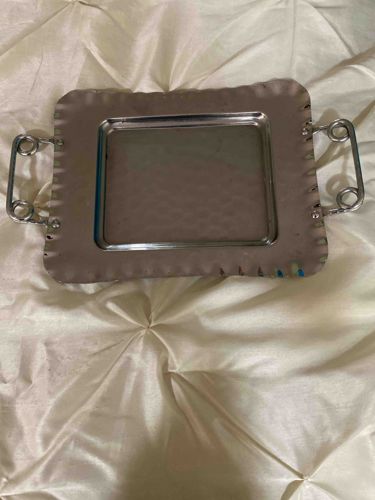
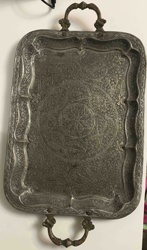
This is a rectangular, silver-toned decorative serving tray or vanity tray, presenting a somewhat rustic yet refined aesthetic. The main body of the tray appears to be made from a metallic material, likely stainless steel or a plated alloy, given its reflective, cool-toned surface. It features a prominent hammered texture across its central, recessed area, which adds visual interest and helps to mask minor scratches or imperfections. The outer perimeter of the tray has an irregular, perhaps hand-formed, scalloped edge, providing a unique and organic feel. This edge is connected to the central flat surface by a slight rise, creating a shallow basin effect.
The tray is equipped with two distinctive handles on opposite shorter sides. These handles are crafted from a thin, tubular metallic material, bent into a stylized 'safety pin' or looped design, and are attached to the main tray body via small, visible rivets or fasteners. The handles also possess a polished, reflective finish, contrasting slightly with the hammered texture of the tray's base. The overall condition appears to be good with some minor surface wear consistent with age and use, including potential smudges or light scratches that are somewhat camouflaged by the hammered texture. The corners of the tray are rounded, enhancing its softer appearance. There are no visible maker's marks or signatures in the provided images. The style suggests a possible mid-20th century to contemporary decorative item, leaning towards a craftsman or artistic interpretation rather than mass-produced uniformity. The craftsmanship on the handles, with their unique form, indicates an attention to decorative detail, hinting at a reasonably good quality item intended for display or light serving.
AI Appraisal Report
Based on my visual examination of the provided image, this silver-toned decorative serving tray or vanity tray with hammered texture appears to be in good overall condition, consistent with its likely use and age. The prominent hammered texture is well-suited for decorative purposes, camouflaging minor surface wear and smudges. I assess the authenticity to be of a decorative item, likely from the mid-20th century to contemporary, intended for aesthetic appeal or light serving. The unique 'safety pin' style handles and irregular scalloped edge suggest a craftsman or artistic approach rather than a purely mass-produced utilitarian piece.
Market conditions for decorative serving trays of this nature are generally moderate. Comparable items in similar condition, often found in vintage or antique markets and online, typically range in price depending on the material, maker, and design. While the design has a distinctive flair, indicating an 'artistic interpretation,' it does not appear to be from a renowned designer or manufacturer, which would significantly increase its value. Demand for such decorative trays is steady, but not particularly high, as it falls into a broad category of home decor. Rarity is low to moderate; while it's not a common mass-produced design, similar unique pieces can be found.
Factors impacting value include its good condition, the appealing hammered texture, and the distinctive design of the handles and edges. However, the lack of discernible maker's marks or provenance limits its collectible appeal. Without a known maker or material composition beyond 'silver-toned,' it primarily holds decorative value. The 'metallic material, likely stainless steel or a plated alloy' noted in the description, if indeed a plated alloy, could be prone to tarnish or wear not visible in the image, which would affect long-term value. Due to these limitations, I am unable to definitively authenticate the exact material composition or attribute it to a specific artisan or period. An in-person examination would allow for closer inspection of wear, material analysis (e.g., specific metal testing), and a thorough search for any subtle marks or signatures not visible in the images. Provenance documentation, if available, would also be crucial for attributing it to a specific maker or era, thereby significantly impacting its value.