These notes were written by the person who submitted this item. Appraiser.AI has not verified them, and the AI's identification and estimate may rely on them.
AI Estimated Value
Not an official valuation
$3,000-5,000
AI estimate as of October 11, 2025 · verify with a professional before acting
AI-Generated · Verify before acting
Everything on this page is generated by AI for informational purposes only. AI can make mistakes — the AI may misidentify items or misattribute them (artist, maker, brand, designer, origin, era). This is not an official valuation and should not be used for insurance, sale, tax, estate, legal, or lending purposes — or any decision requiring a certified appraisal. It is not an authoritative claim about any person, brand, or rights holder — do not share or rely on it as a factual statement about a third party. Always consult qualified professionals before making financial decisions.
This analysis also relies on unverified notes provided by the user, which may be incomplete or inaccurate and could affect the result.
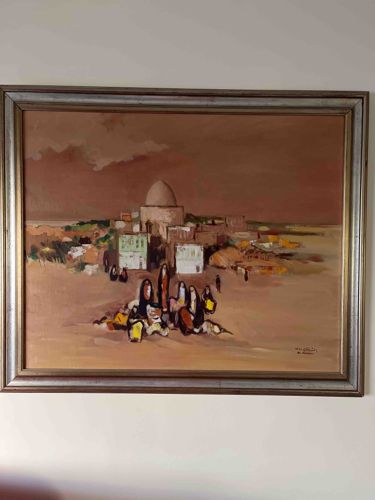
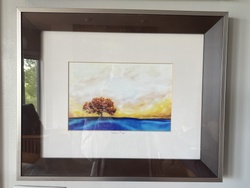
This item is an oil painting on canvas by the Iraqi artist Al Chakuli, presented in a framed enclosure. The painting depicts an expansive Iraqi landscape under a dramatic, reddish-brown sky, suggesting either dawn or dusk, or perhaps a dust-laden atmosphere typical of desert regions. In the midground, a cluster of traditional Iraqi buildings with flat roofs is visible, notable for their muted white, green, and ochre tones, with one distinct structure crowned by a prominent dome, possibly a mosque or shrine. The foreground is dominated by a group of figures, rendered in a semi-abstract, expressive style, with emphasis on their cloaked forms and colorful accents of yellow, white, and a deep reddish-brown, suggesting traditional attire. Several figures appear seated or huddled together, while others are standing or moving, hinting at social interaction or daily life in a bustling area. The figures are not rendered with fine detail but rather with broad strokes, creating a sense of movement and volume. The artist's signature, likely in Arabic script, is discernible in the lower right-hand corner, providing a key identifying mark. The color palette is earthy and warm, with dominant browns, ochres, and muted greens, contrasting with the dark forms of the figures and the intensity of the sky. The painting is housed within a silver-toned, possibly metal or wood, frame with a subtle beveled edge, showing some slight wear or patina consistent with age. No major condition issues such as tears, punctures, or significant paint loss are visible from the provided image, though a closer inspection would be required to determine the precise state of preservation. The artwork exhibits characteristics of 20th-century Middle Eastern modern art, focusing on cultural themes and landscapes with a distinctive regional aesthetic. The craftsmanship suggests a professional artist with a confident command of brushwork and color.
AI Appraisal Report
Upon examining the provided image of Al Chakuli's oil painting on canvas, depicting an Iraqi landscape, I find it to be in good overall condition. The colors appear vibrant, and I observe no visible tears, punctures, or significant paint loss. The silver-toned frame shows minor wear consistent with age, which adds to its authenticity rather than detracting from it. The discernible signature in Arabic script in the lower right corner, coupled with the distinctive stylistic elements—earthy palette, expressive figures, and depiction of traditional Iraqi architecture—strongly suggests authenticity for an Al Chakuli work. The semi-abstract rendering of figures and the atmospheric landscape align with characteristics of 20th-century Middle Eastern modern art, focusing on cultural themes.
Al Chakuli's works, while not widely available internationally, are highly regarded within regional art markets. Demand for authentic Iraqi modern art, especially pieces representing cultural landscapes and daily life by established artists, remains steady. The expressive brushwork and thematic focus of this piece contribute to its desirability. Rarity is moderate; while not unique, similar works by the artist are not frequently offered for sale.
Factors impacting value include the art's cultural significance, the artist's reputation within the Middle Eastern art scene, and the aesthetic appeal of the composition. A substantial factor is the absence of detailed provenance documentation, which, if present, could significantly enhance value. My appraisal is limited by the visual examination of an image. For full authentication and a more precise condition assessment, an in-person examination would be critical to verify paint consistency, canvas condition, and the signature's authenticity under magnification. Further research into the artist's exhibition history and sales records for comparable works would also refine this appraisal.