AI estimate as of August 7, 2025 · verify with a professional before acting
AI-Generated · Verify before acting
Everything on this page is generated by AI for informational purposes only. AI can make mistakes — the AI may misidentify items or misattribute them (artist, maker, brand, designer, origin, era). This is not an official valuation and should not be used for insurance, sale, tax, estate, legal, or lending purposes — or any decision requiring a certified appraisal. It is not an authoritative claim about any person, brand, or rights holder — do not share or rely on it as a factual statement about a third party. Always consult qualified professionals before making financial decisions.
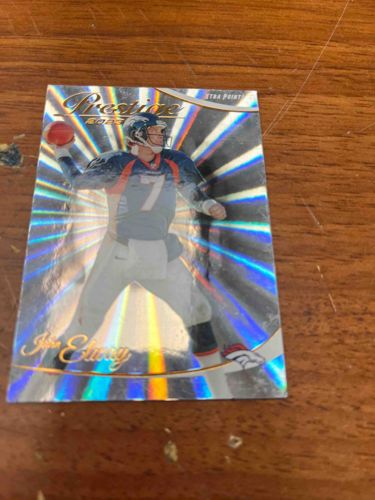
This item is a 2003 Prestige Xtra Point football trading card featuring quarterback John Elway of the Denver Broncos. The card has a standard trading card size, typically around 2.5 by 3.5 inches, and is constructed from cardstock with a distinctive holographic or 'refractor' finish. The primary image on the card depicts John Elway in a throwing motion, wearing his blue and orange Denver Broncos uniform number 7. The background features a radial burst pattern in varying shades of blue, purple, and silver, which reflects light to create a rainbow effect, indicating the 'Xtra Point' parallel or insert designation. The 'Prestige' logo is prominently displayed at the top center, with '2003' subtly integrated below it. The text 'XTRA POINT' is visible in the top right corner. 'John Elway's' signature, or a facsimile thereof, is printed in a stylized gold script across the bottom of the card. The card appears to be in overall good condition with no major creases, tears, or significant surface abrasions visible from the provided image. There may be minor edge wear or corner softening, typical for unencased cards of this age, but this is not definitively clear. The holographic surface appears vibrant and largely intact, without major scratching. The card's design and photographic quality suggest a production standard common for sports cards from the early 2000s, reflecting a mass-produced collectible. The reflective nature of the card enhances its visual appeal and is a key distinguishing feature of this particular insert set.
AI Appraisal Report
Upon examining the provided image of the 2003 Prestige Xtra Point John Elway football card, I assess its condition to be good to very good. The holographic 'refractor' finish appears vibrant and largely intact, without major scratches that would significantly diminish its visual appeal. There are no obvious creases, tears, or significant surface abrasions visible, which is positive. However, as with any card from this era, minor edge wear or corner softening is common, and these details cannot be definitively assessed from an image alone. The card's authenticity, based on visual cues such as logo placement, font style, and overall design, appears consistent with genuine 2003 Prestige Xtra Point cards. The 'Xtra Point' designation implied by the holographic, radial burst background is a key feature.
In terms of market conditions, John Elway remains a highly collectible Hall of Fame quarterback, ensuring a steady demand for his cards. The 'Xtra Point' parallels from this era are generally sought after due to their distinctive visual appeal and relative scarcity compared to base cards, though they are not exceedingly rare. Comparables would include other John Elway 'refractor' or distinctive parallel inserts from the early 2000s, which tend to sell in a moderate price range depending on condition. Factors impacting value include the strong visual appeal of the holographic surface, the enduring popularity of Elway, and the card's perceived good condition.
Limitations in authenticity verification from images alone are significant. While the card appears legitimate, absolute authentication of its originality, and a precise grading of its condition (e.g., PSA 8, 9, 10), would require in-person examination. Physical inspection allows for a closer look at surface imperfections, corner sharpness, centering, and print quality that can drastically affect value. Furthermore, while the signature appears to be a printed facsimile common for mass-produced inserts, genuine authentication of any autograph (if it were represented as an on-card auto) would necessitate forensic examination or established provenance documentation.