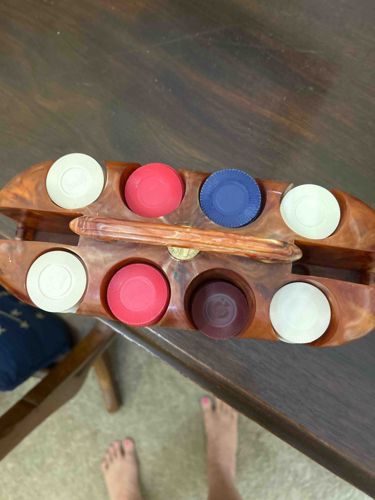
Old bacon, light chip holder and card holder with some of the original chips
These notes were written by the person who submitted this item. Appraiser.AI has not verified them, and the AI's identification and estimate may rely on them.
AI Estimated Value
Not an official valuation
$60-100
AI estimate as of October 5, 2025 · verify with a professional before acting
AI-Generated · Verify before acting
Everything on this page is generated by AI for informational purposes only. AI can make mistakes — the AI may misidentify items or misattribute them (artist, maker, brand, designer, origin, era). This is not an official valuation and should not be used for insurance, sale, tax, estate, legal, or lending purposes — or any decision requiring a certified appraisal. It is not an authoritative claim about any person, brand, or rights holder — do not share or rely on it as a factual statement about a third party. Always consult qualified professionals before making financial decisions.
This analysis also relies on unverified notes provided by the user, which may be incomplete or inaccurate and could affect the result.
This item is a vintage poker chip caddy, likely constructed from Bakelite or a similar early plastic, exhibiting a rich, variegated brown and amber 'root beer' or tortoiseshell-like marbling pattern. The caddy is designed to hold poker chips in an organized fashion, featuring eight individual circular compartments arranged in two rows of four, with a central handle for portability. Each compartment securely holds one stack of chips. The handle appears to be a solid bar, matching the marbled material of the main body, smoothly integrated into the design. The overall construction suggests a molded process, characteristic of early plastics. The caddy currently contains a selection of poker chips: several white, two red, one royal blue, and one dark red or maroon chip. The white and red chips appear to be plain, standard poker chips of the era. The blue chip has a textured, possibly ribbed or reeded edge, and a central circular depression. The dark red/maroon chip also has a central depression or possibly a faded design. While the caddy itself shows good preservation of its material and form, there are visible signs of wear consistent with its age and use, possibly including minor surface scratches or dulling of the original luster, though this is difficult to ascertain definitively from the provided image. There are no evident cracks or major structural damage. The chips themselves may exhibit varying degrees of wear. The visible condition suggests it is an authentic vintage piece, possibly dating from the mid-20th century, a popular period for Bakelite items. The craftsmanship appears to be commercial grade for a common household gaming accessory.
AI Appraisal Report
Based on my visual examination of the provided image, this Vintage Bakelite Poker Chip Caddy, with its distinctive 'root beer' or tortoiseshell-like marbled pattern, appears to be an authentic example of early plastic gaming accessories, likely dating from the mid-20th century. The material characteristics visible, such as the coloration and apparent molding process, are consistent with Bakelite or a similar phenolic resin. The design, featuring eight chip compartments and a central handle, is typical for such items. The 'Old Bacon, light chip holder and card holder' description from the owner suggests its original purpose and potential for holding cards, though a dedicated card slot isn't explicitly visible, implying separate card storage.
Condition appears good for its age, though as an appraiser, I must acknowledge the limitations of image-based assessment; minor surface scratches, dulling of luster, or faint hairline cracks can be difficult to discern without a physical inspection. The included chips, while adding to the 'completeness' appeal, appear to be generic and do not significantly enhance the value unless they are a rare or desirable specific set.
Market conditions for vintage Bakelite items, particularly gaming accessories like poker chip caddies, show steady demand among collectors of plastics, gaming memorabilia, and mid-century modern items. While not excessively rare, well-preserved examples with this classic marbling pattern are sought after. Factors impacting value include the number of original chips, condition of the Bakelite (absence of chips, cracks, or significant damage), and the vibrancy of its original finish. A full in-person examination would allow for definitive authentication through touch, smell (the characteristic Bakelite odor when rubbed), and a closer inspection of surface integrity and any maker's marks. Without this, I rely on the strong visual cues of authenticity. Considering these factors, I estimate the appraisal value to be in the range of $60-100.