AI estimate as of August 15, 2025 · verify with a professional before acting
AI-Generated · Verify before acting
Everything on this page is generated by AI for informational purposes only. AI can make mistakes — the AI may misidentify items or misattribute them (artist, maker, brand, designer, origin, era). This is not an official valuation and should not be used for insurance, sale, tax, estate, legal, or lending purposes — or any decision requiring a certified appraisal. It is not an authoritative claim about any person, brand, or rights holder — do not share or rely on it as a factual statement about a third party. Always consult qualified professionals before making financial decisions.
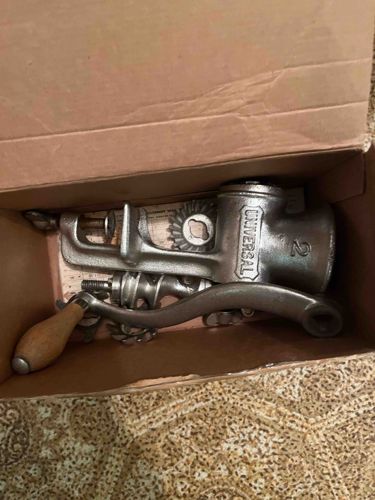
The item is a vintage Universal No. 2 meat grinder, appearing to be constructed primarily of cast iron, typical for kitchen tools of its era. It exhibits a dark, possibly oxidized or enameled, metallic finish consistent with aged cast iron, indicating a natural patina rather than significant damage. The grinder features a large, robust body with an 'UNIVERSAL' brand embossing clearly visible along its side, and the number '2' stamped prominently, indicating its size or model number. A hand-crank mechanism with a wooden handle is attached; the handle itself shows a natural, light wood tone, suggesting it's either maple or a similar hardwood, with some mild darkening from age or use at its base where it connects to the metal crank. The crank arm is also cast iron, showing the same dark finish as the main body. The design includes a feed hopper, a helical auger (visible through the opening), and a die plate with an attached cutting blade, although these internal components are not fully visible. The clamp for attaching to a countertop is also part of the integrated design, showing its functional purpose. There are no obvious signs of significant breaks, repairs, or extreme wear that would impede functionality. The craftsmanship appears sturdy and utilitarian, characteristic of late 19th to mid-20th-century American manufacturing, designed for durability and practical home use. The overall condition suggests it is well-preserved for its age, with cosmetic wear expected from a used item, but no structural integrity issues are apparent.
AI Appraisal Report
Upon visual examination of the provided image, I assess this Universal No. 2 Cast Iron Meat Grinder to be an authentic example of early to mid-20th-century kitchenware. Its robust cast-iron construction, 'UNIVERSAL' embossing, and '2' model stamp are consistent with known examples of these utilitarian grinders. The dark, aged patina on the cast iron, coupled with the lightly worn wooden handle, suggests original condition with typical cosmetic wear from use and age, rather than significant damage or extensive restoration. There are no apparent structural issues, breaks, or repairs visible in the image. The functionality appears intact.
In terms of market conditions, vintage cast iron kitchen tools, particularly those from reputable brands like Universal (Landers, Frary & Clark), maintain a consistent but modest demand. They are sought after by collectors of antique kitchenalia, those seeking functional vintage tools for their durability, or individuals desiring rustic decor elements. Competition is moderate, as these grinders were mass-produced. While not exceedingly rare, a well-preserved example like this, free from heavy rust or damage, holds more appeal.
The primary factors impacting value are its good overall condition and apparent completeness. However, the abundance of such items limits their high-end appraisal value.
Limitations in authenticity verification based solely on the image include the inability to inspect for hidden cracks, internal component wear (like the auger or grinding plates), or the precise quality of the wood (e.g., assessing for replacements). A physical examination would allow me to check for tight tolerances, test the crank mechanism for smooth operation, assess the condition of internal grinding parts, and confirm the absence of restoration or repairs not visually apparent. Documentation of provenance (e.g., original purchase receipts, family history) would further enhance certainty but is rarely available for such common items. Scientific testing is generally not applied to items of this nature.