These notes were written by the person who submitted this item. Appraiser.AI has not verified them, and the AI's identification and estimate may rely on them.
AI Estimated Value
Not an official valuation
$5-10
AI estimate as of July 31, 2025 · verify with a professional before acting
AI-Generated · Verify before acting
Everything on this page is generated by AI for informational purposes only. AI can make mistakes — the AI may misidentify items or misattribute them (artist, maker, brand, designer, origin, era). This is not an official valuation and should not be used for insurance, sale, tax, estate, legal, or lending purposes — or any decision requiring a certified appraisal. It is not an authoritative claim about any person, brand, or rights holder — do not share or rely on it as a factual statement about a third party. Always consult qualified professionals before making financial decisions.
This analysis also relies on unverified notes provided by the user, which may be incomplete or inaccurate and could affect the result.
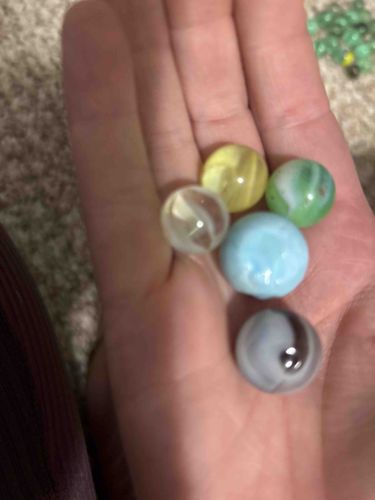
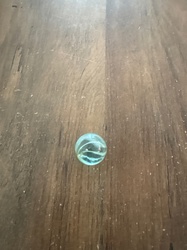
This collection consists of five vintage glass marbles, each approximately 0.5 to 0.75 inches in diameter, held in the palm of a hand. The marbles exhibit a variety of colors and internal patterns. One marble is a clear or translucent white with internal swirling white opaque vanes, typical of an 'aggie' or 'cat's eye' style without the traditional glass 'eye'. Another marble is a vibrant light blue, opaque and uniformly colored, suggesting a 'robin's egg' type. A third marble displays a mix of green and white swirled patterns, characteristic of a 'swirl' or 'cloud' type. The fourth marble is a clear yellow with internal opaque yellow or white swirls, giving it a 'honey' or 'striped' appearance. The fifth marble is a grey or light brown with a distinct dark brown or black swirl pattern, notably featuring a small, perhaps metallic or highly reflective, internal sphere or speck, which is unusual and could indicate a 'core' or 'pelt' type. All marbles appear to be in good vintage condition with a visible smooth, glossy surface, exhibiting some minor wear consistent with play and handling such as tiny nicks or surface abrasions, which contribute to their vintage patina. There are no obvious cracks, chips, or significant damage. The craftsmanship suggests machine-made production, common for marbles from the mid-20th century.
AI Appraisal Report
I have examined the collection of five assorted vintage glass marbles based on the provided image and description. The marbles, measuring approximately 0.5 to 0.75 inches, appear to be machine-made examples common from the mid-20th century. My assessment of their condition is 'good vintage,' showing minor surface wear, small nicks, and abrasions consistent with play, but no significant damage like cracks or large chips. The assortment includes common types such as a white 'aggie' or 'swirl', a light blue opaque, a green and white 'swirl', and a clear yellow with swirls. The fifth marble, a grey/light brown with a dark swirl and a possible internal metallic speck, is the most intriguing and could potentially be a 'peltier' or 'core' type, which can carry slightly more value.
The market for common machine-made marbles is generally modest. While specific rare examples can command high prices, bulk lots of common swirls, opaques, and cat's eyes are widely available. The value here is as a small collectible group rather than for any individual high-rarity piece. The primary factor limiting the value is their common production origin. The small, potentially metallic inclusion in one marble is a point of interest, but without confirmation of its material or manufacturer (like Peltier Glass Co.), its impact on value is minimal.
It is crucial to note that this appraisal is based solely on digital images. A definitive valuation and authentication would require in-person examination to assess the glass quality, identify seams, and confirm the nature of the internal elements. Without physical inspection, it is impossible to definitively attribute them to a specific manufacturer (e.g., Akro Agate, Christensen, Peltier) or to rule out modern reproductions. Full authentication would benefit from examination under magnification and comparison with known, documented examples.