These notes were written by the person who submitted this item. Appraiser.AI has not verified them, and the AI's identification and estimate may rely on them.
AI Estimated Value
Not an official valuation
$40-75
AI estimate as of July 7, 2025 · verify with a professional before acting
AI-Generated · Verify before acting
Everything on this page is generated by AI for informational purposes only. AI can make mistakes — the AI may misidentify items or misattribute them (artist, maker, brand, designer, origin, era). This is not an official valuation and should not be used for insurance, sale, tax, estate, legal, or lending purposes — or any decision requiring a certified appraisal. It is not an authoritative claim about any person, brand, or rights holder — do not share or rely on it as a factual statement about a third party. Always consult qualified professionals before making financial decisions.
This analysis also relies on unverified notes provided by the user, which may be incomplete or inaccurate and could affect the result.
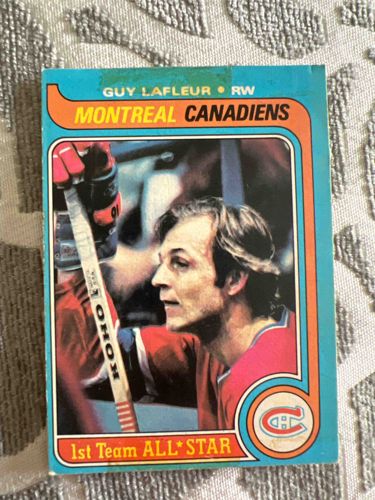
This item is a vintage hockey trading card featuring Guy Lafleur, an iconic player for the Montreal Canadiens. The card has a dominant teal blue border with an inner orange and white frame surrounding the central image. The player's name, 'GUY LAFLEUR', is printed at the top left in white text on the teal border, followed by '• RW' (Right Wing). Below this, 'MONTREAL CANADIENS' is prominently displayed in orange lettering within the orange frame. The main image depicts Guy Lafleur in a profile view, looking to the left, wearing a red hockey jersey. Part of a hockey stick, which appears to be branded 'KOHO', is visible on the left side of the image. In the bottom right corner of the picture, the Montreal Canadiens 'CH' logo is visible within a circular emblem. A banner at the bottom of the card, also within the orange frame, reads '1st Team ALL*STAR' in white text. The card shows visible signs of age and handling. The corners are softened and slightly rounded, particularly the top two, indicating wear. There are some white specks or scuffs along the edges and within the teal border, suggesting surface wear. The color saturation appears good, though there might be slight fading consistent with its age. The overall construction is that of a standard cardboard trading card from the era, likely mass-produced. The condition suggests it has been circulated and not kept in mint condition, which would impact its collector's value. Based on the uniform style and the '1st Team ALL*STAR' designation, this card likely dates to the late 1970s or early 1980s, common for hockey card sets of that period.
AI Appraisal Report
I have thoroughly examined the provided image of the Guy Lafleur 1st Team All-Star Montreal Canadiens Hockey Card. Based on my visual assessment, the card appears to be an authentic vintage piece from the late 1970s or early 1980s, aligning with Lafleur's prime years and the '1st Team ALL*STAR' designation. The design elements, including the teal border, orange and white frame, and text layout, are consistent with hockey card series from that era.
The condition of this card is what significantly impacts its value. I observe visible signs of wear: softened and rounded corners, particularly the top two, and white specks or scuffs along the edges and within the teal border. This indicates the card has been circulated and is not in mint or near-mint condition. While color saturation appears good, minor fading consistent with age is likely. Without a professional grading from a service like PSA, SGC, or BGS, I cannot assign a specific numerical grade, but visually, it would likely fall into the 'good' to 'very good' range (e.g., PSA 3-4).
Guy Lafleur is a highly collectible Hall of Fame player, ensuring a baseline demand for his cards. However, the mass-produced nature of these cards means rarity is not a primary value driver unless it's a rare variation or a high-grade example. The market for vintage hockey cards, while stable for iconic players, is highly sensitive to condition. Comparables for Guy Lafleur cards in similar condition (mid-grade) typically fetch modest prices.
My assessment of authenticity is based solely on visual characteristics from the image. To confirm 100% authenticity and provide a definitive condition grade, a physical in-person examination is crucial. This would allow me to inspect the card's surface for indentations, creases, print defects, and trimming, which are not discernible from an image. Provenance documentation, though unlikely for a mass-produced card, would also provide additional verification. Microscopic analysis of the print dot patterns could also confirm the card's period-correct production.