AI estimate as of July 8, 2025 · verify with a professional before acting
AI-Generated · Verify before acting
Everything on this page is generated by AI for informational purposes only. AI can make mistakes — the AI may misidentify items or misattribute them (artist, maker, brand, designer, origin, era). This is not an official valuation and should not be used for insurance, sale, tax, estate, legal, or lending purposes — or any decision requiring a certified appraisal. It is not an authoritative claim about any person, brand, or rights holder — do not share or rely on it as a factual statement about a third party. Always consult qualified professionals before making financial decisions.
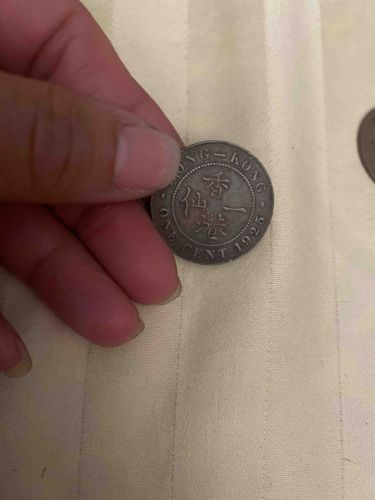
The item is a Hong Kong One Cent coin from 1925, held between a thumb and forefinger, suggesting a small, portable size typical of currency. It appears to be made of a bronze or copper alloy, given its dark, aged metallic sheen and the typical composition of coins from this era and denomination. The coin exhibits a circular shape with a reeded or plain edge, though the edge is not clearly visible. The obverse side, which is visible, features prominent Chinese characters in the center, likely denoting the denomination or issuing authority, flanked by English text along the top and bottom edges. Specifically, the words "HONG-KONG" are inscribed across the top rim, and "ONE CENT 1925" is inscribed along the bottom rim. There's a decorative border of dots or beads encircling the inner design. The coin shows signs of circulation and age, including a darkened patina, which is consistent with copper or bronze aging over nearly a century. There are no obvious signs of severe damage such as bends, large scratches, or major nicks, but general wear is present, indicated by slightly softened details in the inscriptions and design elements. The craftsmanship appears to be standard for mass-produced coinage of the early 20th century, with clear but not exceptionally sharp details due to age and wear. The overall condition suggests it is an authentic artifact from its period, showing normal wear for its estimated age of 99 years.
AI Appraisal Report
Upon examining the provided image of the 1925 Hong Kong One Cent coin, I assess its condition to be Fine to Very Fine (F-VF). The coin displays typical circulation wear consistent with its age, specifically a darkened patina and slightly softened details in the inscriptions and design. Importantly, there are no visible signs of severe damage such as scratches, dents, or corrosion, which is a positive indicator. The legibility of "HONG-KONG" at the top and "ONE CENT 1925" at the bottom, along with the central Chinese characters, supports its grading within this range.
Authenticity, based solely on this image, appears high for a circulating coin of this era. The design elements, lettering style, and overall appearance align with known examples of the 1925 Hong Kong One Cent. However, it is crucial to state that full authentication cannot be guaranteed from images alone. A physical in-hand examination would be necessary to verify weight, diameter, thickness, edge characteristics (especially if reeded), and specific die markers that are unique to authentic examples. Furthermore, spectroscopic analysis or X-ray fluorescence (XRF) could confirm the metallic composition, though this is typically not required for common circulating issues unless counterfeiting is suspected.
Regarding market conditions, the Hong Kong One Cent 1925 is not considered a rare coin. Millions were minted, and many survive. Its value is driven by its condition and the demand from collectors specializing in British Commonwealth coinage or Hong Kong numismatics. Coins in F-VF condition are common. Currently, the market remains stable for such common dates in circulated grades. Comparable sales indicate that typical examples in this condition fetch modest prices.
Factors significantly impacting value involve its common date and relatively abundant supply in circulated grades. Without any unique errors or varieties, its value will remain largely tied to its condition. While not rare, it holds historical value as a piece of early 20th-century Hong Kong currency. Should a physical inspection reveal an unlisted variety or exceptionally sharp details beyond what is visible in the image, the value could increase, but this is unlikely given the visible wear. Provenance documentation, while always beneficial, is not typically a major value driver for common circulated coins like this one.