AI estimate as of July 28, 2025 · verify with a professional before acting
AI-Generated · Verify before acting
Everything on this page is generated by AI for informational purposes only. AI can make mistakes — the AI may misidentify items or misattribute them (artist, maker, brand, designer, origin, era). This is not an official valuation and should not be used for insurance, sale, tax, estate, legal, or lending purposes — or any decision requiring a certified appraisal. It is not an authoritative claim about any person, brand, or rights holder — do not share or rely on it as a factual statement about a third party. Always consult qualified professionals before making financial decisions.
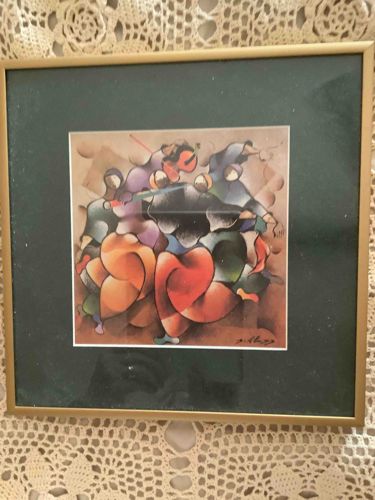
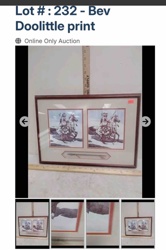
The item is a framed art print depicting an abstract or cubist-style composition of what appear to be human figures or musicians. The central image is a colorful print, likely a reproduction, featuring a palette of warm oranges, reds, and purples, contrasted with cooler greens, blues, and black. The figures are rendered with rounded, volumetric forms, giving them a somewhat abstract and geometric appearance, characteristic of modern art. Some elements suggest musical instruments or a performance. The background of the print is a muted brown or beige tone with subtle geometric or abstract patterns. The print itself appears to be matted with a dark green, possibly forest green, mat board, which serves to highlight the artwork and provide visual separation from the frame. The mat board shows some minor dust or lint specks. The entire piece is enclosed within a slender, metallic-looking frame, which appears to be a light gold or brass tone. The frame has a simple, clean profile. The visible glass over the print has some reflections, suggesting it's intact, but there's a slight glare. A signature is visible in the lower right corner of the print, appearing to be 'K. Alibaz' or similar, followed by '99', indicating a possible date of 1999. The overall condition appears good with no obvious major damage to the print or frame, though minor wear consistent with age might be present on closer inspection.
AI Appraisal Report
Based on my visual examination of the provided image, this framed art print, signed 'K. Alibaz '99', appears to be in good overall condition. The print itself shows no obvious damage; the colors remain vibrant, and the figures, characteristic of a cubist or abstract figural style, are well-preserved. The dark green mat board and slender gold-tone frame complement the artwork. However, some minor dust/lint on the mat and reflections on the glass are noted. This piece is clearly a reproduction, likely a limited edition or open edition print, given its format and the visible signature which appears to be part of the print, not an original hand-signed mark.
Authenticity of the signature and the print's origin cannot be definitively confirmed from an image alone. An in-person examination would be crucial to determine if the signature is original to the print (i.e., part of the printing process) or an original hand-signed addition, and to assess the print's medium (e.g., lithograph, giclée). Provenance documentation, such as a certificate of authenticity or purchase invoice, would be essential for full authentication and to establish if it's a limited edition. Without this, and considering this appears to be a decorative, mass-produced art print rather than an original artwork by a widely recognized artist, its market value is primarily driven by its aesthetic appeal, condition, and decorative quality.
In the current market, decorative art prints by lesser-known or unlisted artists generally command modest values. Demand for such pieces is steady among buyers looking for affordable wall decor. Rarity is not a significant factor here without evidence of a strict limited edition. The value is largely decorative. Factors impacting value negatively include the print's non-original status and its lack of identifiable artist provenance.
To fully authenticate and assess, I would require a physical inspection to verify the print type and signature's originality, and any edition numbering. Without this, my appraisal is based on its decorative market segment.