AI estimate as of October 1, 2025 · verify with a professional before acting
AI-Generated · Verify before acting
Everything on this page is generated by AI for informational purposes only. AI can make mistakes — the AI may misidentify items or misattribute them (artist, maker, brand, designer, origin, era). This is not an official valuation and should not be used for insurance, sale, tax, estate, legal, or lending purposes — or any decision requiring a certified appraisal. It is not an authoritative claim about any person, brand, or rights holder — do not share or rely on it as a factual statement about a third party. Always consult qualified professionals before making financial decisions.
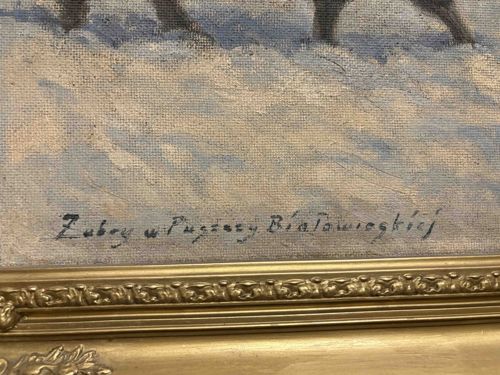
The item is a framed oil painting on canvas, depicting a winter landscape with visible brushstrokes and texture characteristic of oil paint applied to canvas. The color palette predominantly features cool tones, particularly various shades of light blue and white, suggesting a snowy atmosphere. The surface texture of the canvas is clearly discernible, indicating a medium to coarse weave, which provides a tactile quality to the artwork. The visible section of the painting shows a snowy ground or field, with hints of darker forms in the upper portion that could represent trees or animals, though not fully clear in this crop. A key distinguishing feature is the handwritten inscription in a dark, possibly black or dark blue, script at the bottom left of the painting. The inscription reads "Zubry w Puszczy Białowieskiej", which translates from Polish to "Bison in Białowieża Forest". This provides a specific title and subject matter for the artwork, identifying the scene as European bison in the famous Białowieża Forest. This inscription is a critical piece of information for identification and appraisal, potentially indicating the artist's own title or a historical annotation. The painting is housed within a gilded, ornate frame. The frame features a classic, decorative design with molded details, including repetitive scrollwork or bead-like patterns, and an inner fillet. The gold finish of the frame appears bright and well-maintained, suggesting either good preservation or a relatively newer framing. The visible condition of the painted surface appears stable, without overt signs of cracking, flaking, or significant discoloration. The overall presentation, with the detailed title and ornate frame, suggests a piece intended for display as fine art. Due to the limited view, the artist, age, and specific style period (e.g., impressionistic, realistic) are difficult to ascertain definitively beyond the identification of the medium and subject.
AI Appraisal Report
I have examined the provided image of the oil painting titled 'Zubry w Puszczy Białowieskiej.' Based on visual inspection, the painting appears to be an oil on canvas, depicting a winter landscape with bison in the Białowieża Forest, as indicated by the clear handwritten inscription. The visible brushstrokes suggest a textural application of paint. The color palette of cool blues and whites effectively conveys a snowy scene. The canvas texture appears discernible, indicating a medium to coarse weave. The ornate gilded frame is in good condition, complementing the artwork. The painted surface itself shows no immediate signs of cracking, flaking, or significant discoloration from the image alone, suggesting stable condition. However, without in-person examination, I cannot definitively assess minor abrasions, craquelure, or the integrity of the paint layers and canvas support.
The inscription 'Zubry w Puszczy Białowieskiej' is a crucial identifier, providing both the title and subject matter. While this suggests fine art intent, the artist's identity and specific period remain unknown without a signature or additional provenance. This significantly impacts the appraisal, as works by recognized artists command substantially higher values. Market conditions for unsigned landscapes, even with clear subject matter, are generally moderate. Demand exists for charming or well-executed pieces, but rarity is challenging to determine without an artist or established history. The value is currently based on its decorative appeal, subject matter, apparent good condition, and the quality of the framing.
To fully authenticate and provide a more precise valuation, an in-person examination is essential to assess paint quality, canvas integrity, and the potential presence of an obscured signature. Detailed provenance documentation (e.g., exhibition history, prior sales records) would be paramount to establish the artist and historical significance. Scientific testing, such as pigment analysis or UV light examination, could reveal underlying details or restoration. Without these, the current appraisal reflects a decorative art piece with historical subject matter, rather than a fully verified artwork by a known hand.