AI estimate as of October 26, 2025 · verify with a professional before acting
AI-Generated · Verify before acting
Everything on this page is generated by AI for informational purposes only. AI can make mistakes — the AI may misidentify items or misattribute them (artist, maker, brand, designer, origin, era). This is not an official valuation and should not be used for insurance, sale, tax, estate, legal, or lending purposes — or any decision requiring a certified appraisal. It is not an authoritative claim about any person, brand, or rights holder — do not share or rely on it as a factual statement about a third party. Always consult qualified professionals before making financial decisions.
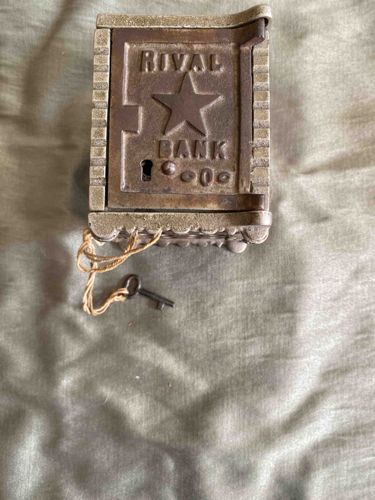
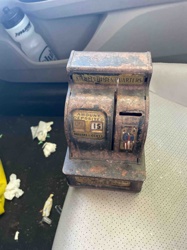
This is an antique cast iron still bank, designed to resemble a miniature building or vault. The primary material is cast iron, exhibiting a dark, almost bronze-like brown color with lighter, possibly aged, brassy or coppery tones on raised edges and decorative elements, indicating a distressed or aged finish. The front face of the bank features the prominent embossed text 'ROYAL' at the top and 'BANK' at the bottom, separated by a large, five-pointed star in the center. Below the word 'BANK', there's a keyhole, suggesting it is a lockable bank, and indeed a small, old-fashioned metal key is visible tied to the bank with a piece of light-colored string. To the right of the keyhole, there are three small, circular embossed elements. The overall construction appears sturdy, typical of cast iron banks from the late 19th to early 20th century. The sides of the bank are textured to mimic brickwork, adding to its architectural aesthetic. The bottom edges feature a decorative, scalloped or beaded border. The condition shows visible signs of age and wear, including surface rust, chips, or abrasions to the paint/finish, and a general patina consistent with an item of its age. There are no obvious repairs visible, and the key appears to be original or at least period-appropriate. This type of bank was popular children's toy and household item, encouraging saving. Its design reflects the industrial aesthetics and common motifs of its era, likely dating from the turn of the 20th century.
AI Appraisal Report
Based on my visual examination of the provided image, this 'Royal Bank' cast iron still bank appears to be a genuine antique, dating from the late 19th to early 20th century. Its robust cast iron construction, architectural styling with brickwork-like texture, and the embossed 'ROYAL BANK' text with a central star are all consistent with known examples of these early mechanical banks. The presence of a keyhole and the visible, period-appropriate key (albeit tied on with string) further supports its authenticity as a functional still bank from that era.
The condition, as observed, shows significant signs of age and use, including wear to the original finish, chipped paint, some visible surface rust, and a general patina. This level of wear is expected for an item of this vintage and does not detract significantly from its value unless it were severely damaged or poorly repaired. Crucially, I see no obvious repairs, which is a positive indicator. The brassy/coppery tones on raised edges suggest original highlights or a distressed, aged aesthetic.
From a market perspective, antique cast iron still banks, especially those with clear branding and good decorative appeal like this 'Royal Bank' example, generally maintain consistent demand among collectors. Comparables for similar 'Royal Bank' models in good, unrestored condition typically range from $250 to $500, with variations depending on paint condition, rarity of specific manufacturing variations, and provenance. The condition of this particular piece places it comfortably within the mid-to-lower end of that range due to the evident paint loss and surface imperfections.
The demand for still banks remains steady, driven by nostalgia, decorative appeal, and their historical context. While not exceptionally rare, banks like this with clear branding and all components present (including the key, even if not original to this specific lock) are desirable. The key's presence, even if not the original working key, adds to its completeness.
Limitations in authenticity verification from image alone: While strong indicators suggest authenticity, a physical examination would be essential to definitively confirm the casting quality, the type and originality of the paint, and the exact match of the key to the lock mechanism. Microscopic analysis of the paint layers could confirm originality, and metallurgical testing could verify the cast iron composition. Provenance documentation, such as original sales receipts or family history, would further enhance its value and confirm its historical journey. Without physical inspection, I cannot rule out the possibility of a high-quality reproduction, although the depicted wear and patina strongly suggest age.