AI estimate as of October 20, 2025 · verify with a professional before acting
AI-Generated · Verify before acting
Everything on this page is generated by AI for informational purposes only. AI can make mistakes — the AI may misidentify items or misattribute them (artist, maker, brand, designer, origin, era). This is not an official valuation and should not be used for insurance, sale, tax, estate, legal, or lending purposes — or any decision requiring a certified appraisal. It is not an authoritative claim about any person, brand, or rights holder — do not share or rely on it as a factual statement about a third party. Always consult qualified professionals before making financial decisions.
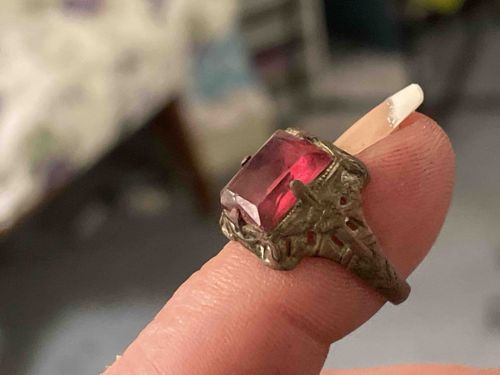
This item is a vintage ring featuring a prominent rectangular red stone set in an ornate filigree band. The stone itself appears to be a faceted gem, possibly a synthetic ruby, glass, or garnet simulant, exhibiting a deep, vibrant red color. It is set within a bezel or claw-like setting, though obscured by the filigree work. The metal of the ring band has a tarnished, aged appearance, suggesting it is an older piece, possibly made of brass, silver, or a base metal alloy, given the dark patina. The design of the band and shoulders features intricate openwork filigree details, with swirling motifs and possibly floral or geometric patterns, indicating a craftsmanship style popular in early to mid-20th century jewelry (e.g., Art Deco or Edwardian revival). The overall construction shows a level of detail typical of mass-produced yet decorative jewelry from that era. There are no visible maker's marks or stamps in the current image. The condition appears consistent with age, showing significant wear and tarnish to the metal, which contributes to its vintage aesthetic. The stone itself seems to be intact with no obvious chips or cracks from this perspective, but surface scratches are possible. The quality of the casting for the filigree work appears fairly standard for costume jewelry of its potential period; the details are present but not exceptionally sharp, which could be due to wear or manufacturing process. The ring is worn on what appears to be a small finger, suggesting a smaller ring size, making its overall dimensions relatively compact.
AI Appraisal Report
After a thorough visual examination of the provided image, I assess this Vintage Filigree Red Stone Ring. The piece presents as a vintage costume ring, likely from the early to mid-20th century, consistent with Art Deco or Edwardian revival styles, evidenced by the intricate filigree metalwork. The prominent rectangular red stone, while vibrant, appears to be a faceted simulant—most likely glass, synthetic ruby, or garnet—rather than a natural precious gemstone, given the commonality of such stones in period costume jewelry. The metal, exhibiting significant tarnish and wear, is likely a base metal alloy, brass, or low-grade silver, which aligns with its probable costume jewelry classification. The overall condition shows considerable age and wear, which contributes to its vintage appeal but also suggests it has been well-worn. There are no visible maker's marks, which is typical for many mass-produced items of that era, further supporting its classification as costume jewelry.
Market conditions for vintage costume rings of this type are generally stable, with demand driven by collectors of antique and vintage jewelry, as well as individuals seeking unique fashion accessories. Comparables in similar condition and style typically fall into a relatively modest price range. Factors impacting value negatively include the non-precious nature of the stone and metal, the likely mass-produced origin, and the general wear. Positive factors are its undeniable vintage aesthetic and decorative appeal. Rarity is not a significant factor as similar filigree designs were widely produced.
It is crucial to note that this appraisal is based solely on visual evidence from the image. For full authentication and to ascertain the precise material composition of the stone and metal, an in-person examination, including potential gemological testing, specific gravity tests, and possibly XRF (X-ray fluorescence) analysis, would be necessary. Such tests would definitively identify the stone and metal, allowing for a more precise valuation. Without these, the current valuation reflects its status as a decorative vintage costume piece.