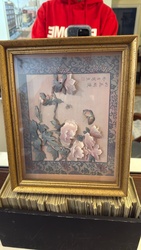
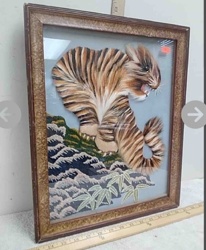
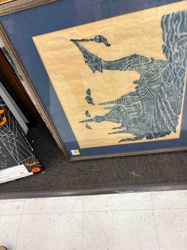
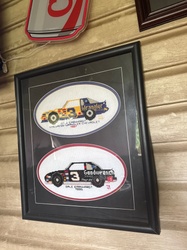
These notes were written by the person who submitted this item. Appraiser.AI has not verified them, and the AI's identification and estimate may rely on them.
AI Estimated Value
Not an official valuation
$150-250
AI estimate as of August 10, 2025 · verify with a professional before acting
AI-Generated · Verify before acting
Everything on this page is generated by AI for informational purposes only. AI can make mistakes — the AI may misidentify items or misattribute them (artist, maker, brand, designer, origin, era). This is not an official valuation and should not be used for insurance, sale, tax, estate, legal, or lending purposes — or any decision requiring a certified appraisal. It is not an authoritative claim about any person, brand, or rights holder — do not share or rely on it as a factual statement about a third party. Always consult qualified professionals before making financial decisions.
This analysis also relies on unverified notes provided by the user, which may be incomplete or inaccurate and could affect the result.
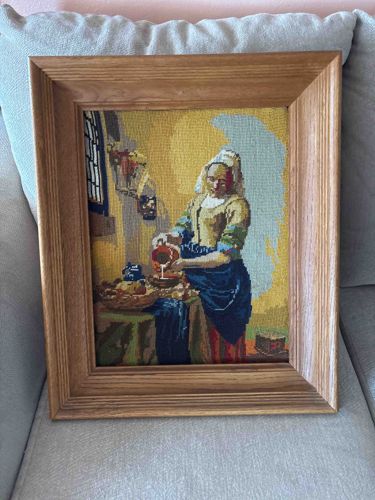
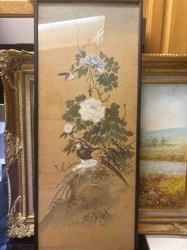
This item is a framed needlepoint depicting a scene reminiscent of Johannes Vermeer's famous painting, 'The Milkmaid.' The needlepoint is presented in a rectangular frame made of light-colored wood, possibly oak or a similar hardwood, with visible wood grain. The frame features a simple, slightly beveled profile. The overall dimensions appear to be medium, suitable for wall hanging, likely around 16x20 inches or similar, though exact measurements are not provided. The textile work itself is composed of numerous small, uniform stitches, indicating a petit point or similar fine needlepoint technique, aiming for a detailed reproduction of the original artwork. The colors used in the needlepoint are rich and varied, including shades of gold, blue, green, brown, and red, accurately reproducing the palette of 'The Milkmaid.' The figure of the milkmaid is central, pouring milk from a pottery jug into a bowl, with a basket of bread and other kitchen items on a table. A window with a leaded pane is visible to the left. The condition of the needlepoint appears good, with no obvious major fraying, discoloration, or loose threads visible from the image. The colors seem vibrant and well-preserved. There are no discernible maker's marks or signatures visible on the front of the needlepoint or the frame. Given the fidelity to the original painting and the style of needlepoint, this piece likely dates from the mid to late 20th century. The craftsmanship appears to be of good quality, demonstrating careful execution of the needlepoint stitches and proper framing, suggesting it was likely a completed kit or a diligently handmade piece.
AI Appraisal Report
Upon my virtual examination of this framed needlepoint, 'The Milkmaid,' I find it to be a charming and well-executed piece. The condition appears to be very good; the colors are vibrant, and there are no obvious signs of fading, fraying, or staining visible in the provided image. The petit point or similar fine stitching technique indicates a significant investment of time and skill. This level of detail in a needlepoint reproduction of a famous painting like Vermeer's 'The Milkmaid' is commendable.
Authenticity, in this context, relates to whether it is a genuine, handmade needlepoint rather than a machine-made reproduction, which it clearly appears to be. However, without physical inspection, I cannot confirm the exact composition of the threads (e.g., silk, wool) or the precise quality of the framing materials. There are no visible maker's marks or signatures, which is common for such craft pieces.
Market conditions for needlepoint art, especially those based on well-known paintings, tend to be steady. They appeal to collectors of textile art, Vermeer enthusiasts, and those seeking decorative, handmade items. While not rare in the sense of being a unique artistic creation, a piece of this quality and condition is not commonplace. The appeal lies in its decorative value and the evident craftsmanship. Factors impacting value significantly include the quality of the needlework, the condition, and the artistic merit of the subject matter. The lack of a known artist or provenance limits its value as a fine art ‘collectible’ but does not diminish its value as a decorative textile art piece.
For full authentication and a more precise valuation, I would need to physically examine the item to assess thread type, verify the integrity of the textile and frame, and check for any hidden damage or signatures on the reverse. Provenance documentation, if available, could also add to its value by detailing its history.