AI estimate as of August 12, 2025 · verify with a professional before acting
AI-Generated · Verify before acting
Everything on this page is generated by AI for informational purposes only. AI can make mistakes — the AI may misidentify items or misattribute them (artist, maker, brand, designer, origin, era). This is not an official valuation and should not be used for insurance, sale, tax, estate, legal, or lending purposes — or any decision requiring a certified appraisal. It is not an authoritative claim about any person, brand, or rights holder — do not share or rely on it as a factual statement about a third party. Always consult qualified professionals before making financial decisions.
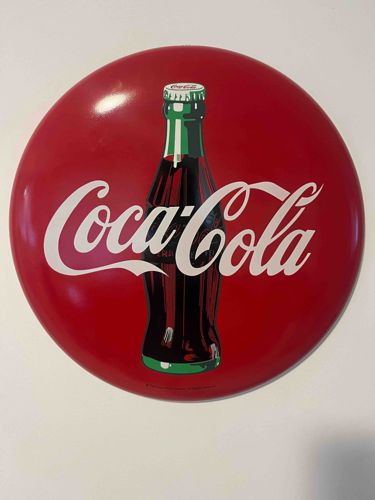
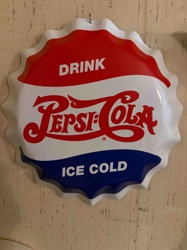
This item is a circular, convex Coca-Cola advertising sign, likely made of tin or embossed metal, consistent with vintage or retro advertising pieces. The sign features a vibrant, glossy red background, which is characteristic of the Coca-Cola brand. Prominently displayed in the center is a highly detailed illustration of a classic green glass Coca-Cola contour bottle, filled with the dark brown cola liquid. The bottle's cap is visible, featuring a white top with green accents. The iconic 'Coca-Cola' Spencerian script logo is printed in white over the bottle image, with 'Coca' to the left and 'Cola' to the right of the bottle, partially overlapping it. The craftsmanship appears to be of good quality, with clear printing and bright, saturated colors. There are no significant visible condition issues such as major dents, deep scratches, or rust, which would indicate good preservation. A subtle sheen suggests a reflective surface, possibly due to a clear protective coating. The slightly convex shape adds a dimensional quality to the sign. While no specific maker's marks or manufacturing dates are discernible from the image, this style of advertising sign, particularly with the classic bottle and logo, is typically associated with the mid to late 20th century. The overall appearance suggests a piece that has been well-maintained or is a more recent reproduction designed to replicate vintage aesthetics. It serves as a decorative item that evokes nostalgia for the brand.
AI Appraisal Report
Based on my visual examination of the provided image, this Coca-Cola Classic Contour Bottle Advertising Sign appears to be in excellent condition. The vibrant red background, the clear and detailed illustration of the contour bottle, and the crisp white Spencerian script logo are all well-preserved. There are no readily apparent major dents, scratches, or rust, suggesting either careful handling over time or that it is a high-quality reproduction. The convex shape adds depth, enhancing its visual appeal.
From the image alone, definitive authentication as an original vintage piece is challenging. While the style aligns with mid to late 20th-century Coca-Cola advertising, the lack of visible maker's marks, production dates, or specific aging indicators makes it difficult to distinguish between an authentic vintage item and a modern, high-quality reproduction designed to evoke nostalgia. The subtle sheen could be indicative of a protective coating used on both new and well-preserved old signs.
Market conditions for Coca-Cola memorabilia are consistently strong, driven by widespread brand recognition and a large collector base. Vintage advertising signs, especially those in good condition depicting iconic imagery like the contour bottle, are generally in demand. Comparables for authentic vintage signs of this size and condition often range from $150 to $400, depending on rarity and provenance. However, if this is a modern reproduction, its value would likely fall between $50 and $150.
To fully authenticate this sign, an in-person examination would be crucial to assess the material properties (e.g., specific tin gauge, paint composition, aging characteristics such as subtle crazing or oxidation), manufacturing techniques, and to search for any hidden marks or dates. Provenance documentation, such as original sales receipts or historical ownership records, would also significantly aid in verification. Scientific testing of materials, if necessary, could further confirm its age and authenticity. Without this, I must include the possibility of it being a reproduction in my valuation.