AI estimate as of September 29, 2025 · verify with a professional before acting
AI-Generated · Verify before acting
Everything on this page is generated by AI for informational purposes only. AI can make mistakes — the AI may misidentify items or misattribute them (artist, maker, brand, designer, origin, era). This is not an official valuation and should not be used for insurance, sale, tax, estate, legal, or lending purposes — or any decision requiring a certified appraisal. It is not an authoritative claim about any person, brand, or rights holder — do not share or rely on it as a factual statement about a third party. Always consult qualified professionals before making financial decisions.
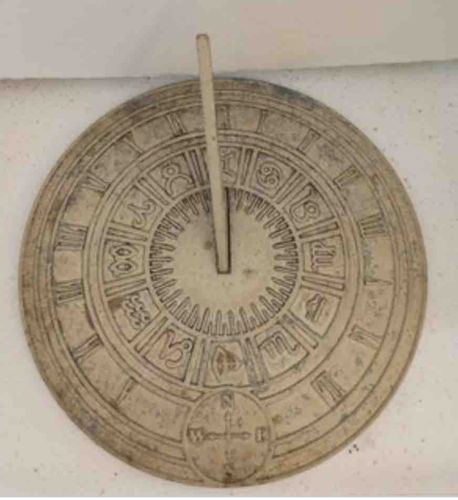
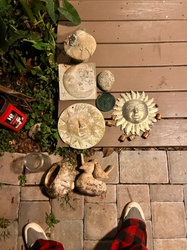
This item is a circular, flat-faced sundial, likely constructed from a cast material such as bronze, brass, or a resin composite designed to mimic metal, given its uniform, somewhat matte, earthy brownish-beige color. The central gnomon, which casts the shadow to indicate time, is a simple, straight rod, tapering slightly at the top, firmly affixed to the center of the dial. The dial face is intricately decorated with several concentric rings of etched or molded details. The outermost ring appears to display Roman numerals, indicating hours, some of which are partially visible (e.g., 'XI', 'XII', 'I'). Inside this, there is a ring featuring various astrological symbols or signs of the zodiac, each contained within its own segmented compartment. Further inward, another ring displays smaller, possibly numerical or symbolic markings, some of which appear to be stylized Arabic numerals. The innermost ring, surrounding the gnomon's base, has radial markings that likely correspond to half-hour or quarter-hour increments. At the bottom of the dial, centered below the main time-telling mechanism, there is a distinct compass rose design, indicating North ('N'), South ('S'), East ('E'), and West ('W'), further integrating astrological or directional elements into its function or aesthetic. The overall condition shows signs of age and outdoor exposure, with a visible patina and some minor discoloration, particularly in the recessed areas, which gives it an antiqued appearance. There are no obvious glaring damages like cracks or significant chips visible from the provided image, suggesting reasonable durability or careful handling. The craftsmanship appears to be of good quality, with clear, well-defined etchings and a solid construction, suitable for outdoor ornamental and functional use. The style suggests it could be a reproduction or a piece from the late 20th or early 21st century designed to evoke a classical or vintage astronomical instrument.
AI Appraisal Report
I have examined the Astrological Garden Sundial based on the provided image. Visually, the sundial appears to be in good condition, showing expected signs of outdoor exposure and patina consistent with its likely use as a garden ornament, without obvious structural damage like cracks or chips. The etched details, including Roman numerals, astrological symbols, and the compass rose, are clear and well-defined. My assessment of its authenticity, based solely on the image, suggests it is a decorative, modern reproduction designed to evoke classical astronomical instruments, likely from the late 20th or early 21st century. The uniform, somewhat matte brownish-beige color points towards a cast material such as bronze, brass, or a resin composite designed to mimic metal.
Market conditions for garden sundials of this decorative type are generally moderate. Comparables typically sell in the range of $50-$200, depending on material, size, and intricacy. Items made from genuine bronze or brass would command prices at the higher end or slightly above, while resin composites would be at the lower end. Demand for such items is consistent but not high, primarily from individuals seeking garden decor. Rarity is low, as similar decorative sundials are readily available from garden centers and online retailers.
Factors impacting value include its good aesthetic condition and intricate detailing, which enhance its appeal as a decorative piece. However, without physical examination to confirm the material (e.g., metal vs. resin), the precise value is speculative. For full authentication and to determine the exact material composition, an in-person examination, potentially including magnet tests for ferrous metals or specific gravity tests for material density, would be crucial. Provenance documentation could also provide insight into its manufacturing date and origin. Based solely on the visual information, I estimate its appraisal value to be between $75 and $150.