These notes were written by the person who submitted this item. Appraiser.AI has not verified them, and the AI's identification and estimate may rely on them.
AI Estimated Value
Not an official valuation
$60 - $120
AI estimate as of October 22, 2025 · verify with a professional before acting
AI-Generated · Verify before acting
Everything on this page is generated by AI for informational purposes only. AI can make mistakes — the AI may misidentify items or misattribute them (artist, maker, brand, designer, origin, era). This is not an official valuation and should not be used for insurance, sale, tax, estate, legal, or lending purposes — or any decision requiring a certified appraisal. It is not an authoritative claim about any person, brand, or rights holder — do not share or rely on it as a factual statement about a third party. Always consult qualified professionals before making financial decisions.
This analysis also relies on unverified notes provided by the user, which may be incomplete or inaccurate and could affect the result.
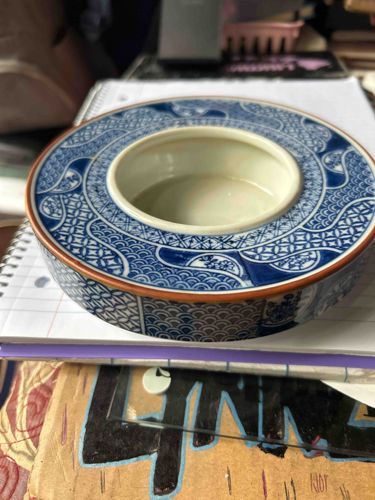
This item is a circular, shallow porcelain vessel, likely functioning as a ring bowl, trinket dish, or possibly a small planter given its overall form. It features a distinctive Japanese Imari-style decoration in rich cobalt blue and white, with outlines and accents in a reddish-brown or rust color, particularly visible on the rim. The central circular well has an unadorned, off-white interior. Surrounding this well, the flat top surface of the bowl is intricately decorated with a series of repeating geometric and stylized patterns. These include wave motifs (seigaiha), interlocking geometric shapes (possibly a version of shippo or key fret patterns), and what appear to be floral or cloud-like elements interspersed. The exterior sidewall of the bowl also exhibits similar blue and white patterns, creating a cohesive design. The rim of the bowl and the circular opening for the central well are highlighted with the reddish-brown/rust glaze, providing a warm contrast to the predominant blue and white. The construction appears sturdy, made from a high-fired porcelain or ceramic material. No visible chips, cracks, or significant wear are apparent from the provided images, suggesting it is in good to excellent condition. The craftsmanship appears to be of good quality, with clear delineation of the painted patterns. The style suggests an origin from the mid-20th century to contemporary production, drawing heavily from traditional Japanese Imari patterns.
AI Appraisal Report
I have examined the provided image and details of this circular porcelain vessel, identified as a Japanese Imari-style ring bowl, trinket dish, or small planter. Based on this visual assessment, the item appears to be in excellent condition, showing no visible chips, cracks, or significant wear. The Imari-style decoration in cobalt blue and white, with reddish-brown/rust accents, is well-executed with clear delineation, suggesting good quality craftsmanship.
Authenticity: From images alone, it is challenging to definitively authenticate its exact age or origin beyond 'Imari-style.' The design, while traditional, suggests a more contemporary production, likely mid-20th century to present. A physical inspection would be crucial for examining the glaze quality, porcelain body, weight, and any potential maker's marks on the base, which are not visible here. Without a physical examination or provenance documentation (e.g., origin certificates, purchase receipts), it's impossible to rule out a reproduction or a piece made for export markets adhering to the Imari aesthetic.
Market Conditions and Comparables: The market for modern or contemporary Imari-style decorative porcelain is generally stable but not highly lucrative. Pieces in excellent condition like this, offering decorative appeal for home use, find ready buyers. Comparables in online marketplaces and specialty antique/decorative arts shops for similar contemporary Imari-style ring dishes or small bowls typically range from $50 to $150, depending on precise age, quality, and origin.
Demand and Rarity: Items of this nature are not rare; mass production of decorative Imari-style porcelain is common. Demand is driven by aesthetic preference rather than rarity or historical significance. Factors impacting value include the lack of specific maker's marks or demonstrable antique age. A physical examination could reveal details improving value, such as a known manufacturer, higher quality porcelain, or evidence of earlier production. However, based on current information, it is a decorative rather than an antique collectible piece.