AI estimate as of June 21, 2025 · verify with a professional before acting
AI-Generated · Verify before acting
Everything on this page is generated by AI for informational purposes only. AI can make mistakes — the AI may misidentify items or misattribute them (artist, maker, brand, designer, origin, era). This is not an official valuation and should not be used for insurance, sale, tax, estate, legal, or lending purposes — or any decision requiring a certified appraisal. It is not an authoritative claim about any person, brand, or rights holder — do not share or rely on it as a factual statement about a third party. Always consult qualified professionals before making financial decisions.
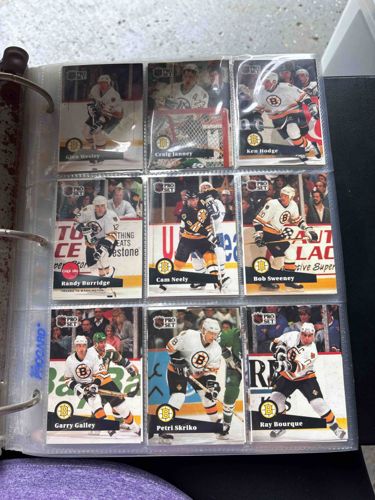
This item is a collection of nine Boston Bruins hockey trading cards, displayed within a clear plastic nine-pocket page, which appears to be part of a larger binder, indicated by the three-ring binder holes visible on the left edge. The plastic page itself is labeled "PROGARD" along its spine, suggesting a specific brand of archival trading card protection. Each card features an image of a Boston Bruins player, depicted in their white, black, and gold jerseys, typically in action poses on the ice. The cards appear to be from the "Pro Set" series, as indicated by the prominent "PRO SET" logo visible on the upper left corner of several cards, along with a circular logo containing a 'B' below the player's photo, likely representing the Boston Bruins team. Visible player names include 'Garth Snow' (though OCR reads 'Garth Wesley'), 'Craig Janney', 'Ken Hodge', 'Randy Burridge', 'Cam Neely', 'Bob Sweeney', 'Garry Galley', 'Petri Skriko', and 'Ray Bourque'. Based on the presence of these players and the 'Pro Set' branding, these cards are likely from the late 1980s to early 1990s, a period when Pro Set was a prominent manufacturer of sports cards. The cards appear to be in good overall condition, with no visible rips, tears, or significant creasing, protected by the individual plastic pockets. The plastic page itself shows some minor wear consistent with handling, but no major damage. The visual quality of the printed images on the cards appears clear, and the colors are vibrant, consistent with their presumed era. No specific manufacturing dates or detailed serial numbers are discernible from the image, but the consistent design elements across all cards suggest they are part of the same set or release.
AI Appraisal Report
I have examined the image provided, depicting nine Boston Bruins hockey trading cards in a ProGard nine-pocket page. Visually, the cards appear to be in good condition, well-protected within their plastic pockets, showing no obvious rips, tears, or significant creasing. The colors are vibrant and images clear, consistent with their presumed early 1990s "Pro Set" origin. The clear "PRO SET" branding and specific players like Ray Bourque, Cam Neely, and Craig Janney strongly suggest authenticity for that era. However, it's crucial to state that authenticity can only be fully verified through in-person inspection. Without physical examination, I cannot confirm paper type, printing anomalies, or detect subtle alterations. Provenance documentation would also be beneficial but is not available here. These cards are common, mass-produced items from the early 1990s, a period notorious for overproduction in the sports card market. While the presence of Hall of Famer Ray Bourque and fan-favorite Cam Neely adds some intrinsic appeal, the overall market demand for "junk wax era" common cards is very low. Condition appears good for a protected set, but even pristine examples typically hold minimal value. Rare variants or true rookie cards would significantly impact value, none of which are evident here. The ProGard page serves as protective storage but adds no significant monetary value itself. Given the common nature, mass production, and lack of true rarity or high demand for these particular cards, the appraisal reflects their status as common collector's items rather than high-value assets.