AI estimate as of July 10, 2025 · verify with a professional before acting
AI-Generated · Verify before acting
Everything on this page is generated by AI for informational purposes only. AI can make mistakes — the AI may misidentify items or misattribute them (artist, maker, brand, designer, origin, era). This is not an official valuation and should not be used for insurance, sale, tax, estate, legal, or lending purposes — or any decision requiring a certified appraisal. It is not an authoritative claim about any person, brand, or rights holder — do not share or rely on it as a factual statement about a third party. Always consult qualified professionals before making financial decisions.
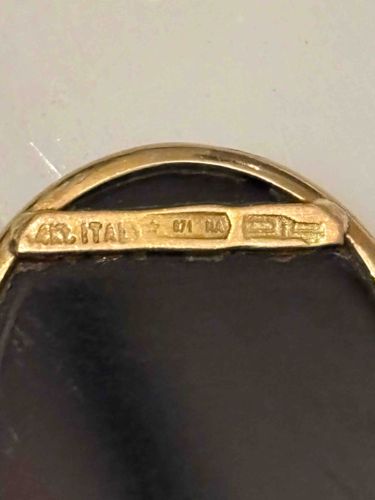
The item appears to be the reverse side or setting of a piece of jewelry, likely a pendant, brooch, or possibly a ring, given the visible 'frame' structure surrounding a dark inlay. The primary material is a polished gold-toned metal, presumably gold, which forms a robust bezel or setting around a dark, flat, and somewhat reflective surface. This dark element could be onyx, obsidian, black glass, or perhaps even a highly polished dark wood or stone. The metal exhibits a smooth, bright finish with some minor surface scratches and possibly slight patination, particularly in the recessed areas, which is consistent with age and regular wear.
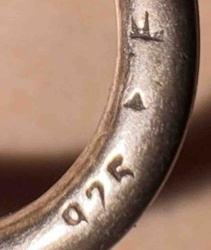
Crucially, there are several clearly inscribed hallmarks on the gold-toned metalwork. Visible markings include '14K', indicating the gold purity (14 karat), and 'ITALY', specifying its country of origin. Another stamp '671 NA' is present, which likely represents a manufacturer's mark or assay office code, potentially 'NA' for Napoli (Naples, Italy). The presence of these marks suggests fine craftsmanship and adherence to specific standards. The construction appears sturdy, with a well-formed bezel securely holding the dark inlay. The quality of the engraving for the hallmarks is precise, indicating a professional manufacturing process. There are no obvious signs of significant damage, repairs, or breaks, although further assessment would require viewing the obverse side of the piece.
AI Appraisal Report
Upon examining the provided image, this item presents as the reverse of a gold-toned jewelry piece, likely a pendant or brooch. The dominant material is a polished gold-toned metal, featuring a robust bezel setting around a dark, flat inlay, which could be onyx or black glass. Its condition appears good, with expected minor surface scratches consistent with age and wear; no significant damage or repairs are evident.
Authenticity is strongly suggested by the clearly visible hallmarks: '14K' for gold purity and 'ITALY' for country of origin. The '671 NA' mark is likely a manufacturer's or assay office stamp, with 'NA' possibly denoting Naples. These marks indicate professional manufacturing and adherence to quality standards, bolstering its perceived authenticity.
Market conditions for 14K Italian gold jewelry components, especially those with classic designs, generally remain stable. While this is primarily a setting, its inherent gold value (based on the '14K' mark) forms a strong base for its appraisal. Demand exists for such components, either for restoration or re-purposing, particularly given the Italian origin, which is often associated with quality craftsmanship. Rarity is not exceptionally high unless the obverse reveals unique artistic merit or historical significance.
Factors significantly impacting value include the precise weight of the 14K gold, the material and quality of the dark inlay (e.g., onyx versus glass), and the design of the unseen front. Without knowing the gross weight of the 14K gold component, establishing a precise melt value is impossible.
Limitations in authenticity verification from images alone are significant. While the hallmarks appear legitimate, a physical inspection would allow for tactile assessment of material integrity, precise measurement of gold weight, and verification of the inlay material (e.g., specific gravity test for onyx). Microscopic examination could confirm the clarity and depth of hallmarks, and provenance documentation, if available, would further authenticate its history and origin. For full authentication and a definitive appraisal, an in-person examination by a qualified gemologist or appraiser with specialized equipment is essential.