AI Appraisal Estimate

AI-generated estimates · not official valuations

From the user

What was submitted

Photo and notes provided by the user — not generated by AI

Submitted item photo
Submitted photo · May 30, 2026

User's notes

No additional notes provided.

AI analysis below

AI appraisal

AI analysis & estimate

AI-Generated · Verify before acting

Everything below is generated by AI for informational purposes only. AI can make mistakes — the AI may misidentify items or misattribute them (artist, maker, brand, designer, origin, era). This is not an official valuation and should not be used for insurance, sale, tax, estate, legal, or lending purposes — or any decision requiring a certified appraisal. It is not an authoritative claim about any person, brand, or rights holder — do not share or rely on it as a factual statement about a third party. Always consult qualified professionals before making financial decisions.

Read the full disclaimer

AI Identification

·Not independently authenticated·Verify before acting

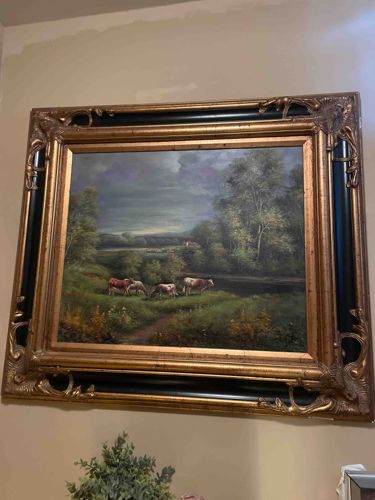
Pastoral Landscape with Cattle in Ornate Gilt and Ebonized Frame

Fine Art / Paintings

AI Estimated Value

·Not an official valuation·Verify before acting

$1,200 - $1,800

As of May 30, 2026

AI Item Analysis

·AI can make mistakes·Verify before acting
This item is a representational oil painting on canvas or board, depicting a pastoral scene with four grazing cattle along a riverbank. The composition features a dense grouping of deciduous trees to the right and a distant landscape under a dramatic, cloudy sky. The color palette is dominated by earthy greens, browns, and muted blues. The painting is housed in a substantial, highly ornate composite or wood frame with a black ebonized cove and gilded raised relief scrolls and floral motifs at the corners and centers. Physically, the frame shows significant scale compared to the artwork. The style is reminiscent of 19th-century European landscape painting, particularly the Hudson River School or Dutch pastoral traditions, though its precise age could range from the late 19th century to a mid-20th-century revival piece. Condition-wise, the frame shows some minor dust accumulation and potential light wear to the gilt finish, while the painting surface appears stable with no immediate signs of flaking or major canvas sagging. No artist signature is visible in the provided image. The craftsmanship of the frame indicates a high-decorative value, featuring deep relief carving or molding.


AI Appraisal Report

·AI can make mistakes·Verify before acting
I have conducted a visual examination of this pastoral oil painting. The work demonstrates high-level decorative appeal, adhering to 19th-century academic traditions. The composition is well-balanced, utilizing a classic 'repoussoir' technique with the tree line to guide the eye toward the grazing cattle and distant horizon. The frame is a significant value-add; it is a substantial, high-relief ebonized and gilded composite frame that appears to be in good condition, likely dating from the late 19th or early 20th century. Market demand for unsigned pastoral scenes remains steady among interior designers and traditional collectors. However, the lack of a visible signature limits the piece to 'decorative' rather than 'investment grade' fine art. The current valuation is based on similar sales of unattributed 19th-century European school landscapes at regional auction houses. The ornate frame alone represents a significant portion of the value, as such craftsmanship is costly to replicate or restore. Several limitations exist in this remote assessment. To finalize authentication, an in-person inspection is required to check for hidden signatures under the frame lip, examine the stretcher bars and nail types for accurate dating, and use UV light (Wood's lamp) to identify areas of overpainting or restoration. Provenance documentation or a gallery label on the reverse would be necessary to elevate this piece from an 'Anonymous School' attribution to a specific artist, which could potentially double or triple the valuation provided here. Scientific testing of pigment binders would be the final step to confirm a 19th-century origin versus a mid-20th-century revival.

Get your items appraised

Instant estimates of your treasures with AI-powered appraisals

Browse More Appraisals