AI estimate as of October 10, 2025 · verify with a professional before acting
AI-Generated · Verify before acting
Everything on this page is generated by AI for informational purposes only. AI can make mistakes — the AI may misidentify items or misattribute them (artist, maker, brand, designer, origin, era). This is not an official valuation and should not be used for insurance, sale, tax, estate, legal, or lending purposes — or any decision requiring a certified appraisal. It is not an authoritative claim about any person, brand, or rights holder — do not share or rely on it as a factual statement about a third party. Always consult qualified professionals before making financial decisions.
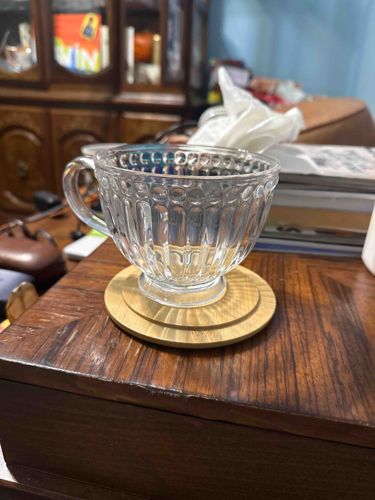
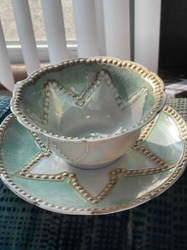
This item is a clear pressed glass teacup, presenting a classic and decorative appearance. The cup features a distinct ribbed pattern extending vertically from the foot to just below the rim, interspersed with a hobnail or button-like texture, particularly evident towards the upper portion of the bowl. The glass itself appears to be of moderate thickness, suggesting durability, and is entirely transparent, allowing for visibility of its contents. A C-shaped handle, also made of clear glass, is attached to one side, designed for comfortable gripping. The teacup stands on a short pedestal foot, elevating it slightly. Its construction indicates it was likely mass-produced through a pressing method, common for creating intricate patterns in glass. There are no immediately visible chips, cracks, or significant wear on the glass, suggesting it is in good to excellent condition. No specific maker's marks or signatures are discernible from the provided images. The style harks back to popular designs found from the late 19th to mid-20th century in pressed glass tableware, often referred to as 'pattern glass.' The cup is currently resting on a light-colored wooden coaster, which has a natural grain and a raised circular lip to presumably secure the cup. The coaster itself has a simple, clean design, complementing the teacup without distracting from it. The craftsmanship of the glass teacup, while likely a mass-produced item, demonstrates careful mold-making to achieve the detailed patterns. The overall aesthetic is one of functional elegance, suitable for everyday use or display.
AI Appraisal Report
I have visually examined the provided image of this clear pressed glass teacup with a ribbed and hobnail design, resting on a wooden coaster. The teacup appears to be in good to excellent condition, showing no visible chips, cracks, or significant wear. Its transparency is clear, and the molded patterns are well-defined, suggesting careful production and relatively gentle use. This type of pattern glass is characteristic of mass-produced items from the late 19th to mid-20th centuries, commonly referred to as 'pattern glass.'
Authenticity, based purely on visual inspection, is consistent with known examples of pressed glass from this era. Specific factory identification or designer attribution is not possible without a discernible maker's mark, which is absent here. An in-person examination would be crucial to detect any hairline fractures, internal flaws, or subtle wear patterns not visible in images, as well as to confirm the exact manufacturing technique and glass quality. Provenance documentation, if available, would further authenticate its history.
Regarding market conditions, pressed glass teacups, even with attractive designs like this one, generally command modest prices. They are not considered rare, as millions were produced. Demand is steady among collectors of 'pattern glass' or vintage kitchenware, but prices are typically low due to the high volume of surviving pieces. The added wooden coaster, while complementary, is a utilitarian item and does not significantly enhance the value beyond a few dollars.
Factors significantly impacting value upwards would include rarity of the pattern (which is unlikely here), historical significance, or association with a renowned manufacturer (e.g., Fostoria, Cambridge) – factors not identifiable from the image. Conversely, any damage would decrease value. Based on comparables found in online marketplaces and antique shops for similar untitled pattern glass teacups, a valuation of $10-25 seems appropriate for the set. This reflects its decorative appeal and good condition, balanced against its commonality and lack of distinct provenance.