AI estimate as of October 25, 2025 · verify with a professional before acting
AI-Generated · Verify before acting
Everything on this page is generated by AI for informational purposes only. AI can make mistakes — the AI may misidentify items or misattribute them (artist, maker, brand, designer, origin, era). This is not an official valuation and should not be used for insurance, sale, tax, estate, legal, or lending purposes — or any decision requiring a certified appraisal. It is not an authoritative claim about any person, brand, or rights holder — do not share or rely on it as a factual statement about a third party. Always consult qualified professionals before making financial decisions.
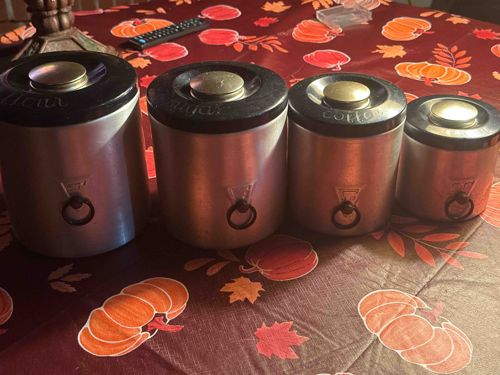
This is a set of four vintage Mirro aluminum kitchen canisters, likely dating from the mid-20th century, possibly the 1940s to 1960s, given their style and material. The canisters are cylindrical with a brushed or satin aluminum finish, varying in height to accommodate different capacities. Each canister features a black bakelite or plastic lid with 'Bakelite' being more likely for the estimated age. Recessed into the center of each lid is a small, brass-tone metal knob, which appears to be decorative rather than functional for sealing, as the lids themselves seem to rest on top. \r\n\r\nOn the front of each canister, just below the lid, is an embossed or debossed label indicating its contents: 'Flour', 'Sugar', 'Coffee', and 'Tea'. The largest canister is labeled 'Flour', followed by 'Sugar', then 'Coffee', and finally the smallest 'Tea', indicating a standard sizing convention for these sets. Below the label, each canister features a distinctive, stylized 'M' or 'W' logo, which is characteristic of the Mirro brand. Beneath this logo, there is a small metal ring handle, perhaps for easier gripping or pulling the canister from a shelf, although these look more decorative given their size. \r\n\r\nThe overall condition appears to be good for their age, showing some expected signs of wear such as minor scratches, scuffs, and perhaps some slight discoloration on the aluminum surfaces, consistent with regular use over decades. The brass-tone knobs on the lids also show some patination or tarnishing. The black lids appear relatively intact, though specific condition of their sealing ability (if any was intended) cannot be fully assessed from the image. The craftsmanship points to a utilitarian yet aesthetically pleasing design common in post-war American kitchens. No significant damage like dents or major corrosion is immediately visible.
AI Appraisal Report
Based on my visual examination of the provided image, this Vintage Mirro Aluminum Kitchen Canister Set appears to be authentic and consistent with Mirro products from the mid-20th century (1940s-1960s). The stylized 'M' logo, material (brushed aluminum), black Bakelite-style lids, and brass-tone knobs are all characteristic markers of Mirro’s canister sets from that period. The graduated sizing for Flour, Sugar, Coffee, and Tea is also standard for these utilitarian sets.
The overall condition is good for its age, showing expected signs of use such as minor scratches, scuffs, and slight patination on the aluminum and brass knobs. Crucially, no significant dents or corrosion are visible, which would severely impact value. The lids appear intact, although I cannot assess their sealing efficacy or confirm the material as true Bakelite without a physical inspection (a hot needle test or detailed observation of mold lines would be required).
Market conditions for vintage kitchenware, especially common brands like Mirro, are generally stable but not experiencing significant appreciation. These sets are popular as decorative items or for light use. Comparables for complete, good-condition Mirro aluminum canister sets typically range from $30 to $80, depending on condition and sales venue. Sets with significant dents, missing lids, or heavy corrosion sell for less. Demand is consistent but not high-fever; they are not particularly rare.
Key factors impacting value here are the completeness of the set (all four canisters and lids appear present) and the relatively good condition. The lack of major damage is a strong positive. Limitations in authenticity verification from images alone include the inability to definitively confirm the lid material (Bakelite vs. later plastic), the precise grade of aluminum, or detect subtle damage not visible in the provided resolution. A physical inspection would allow for tactile assessment of material, a more thorough hunt for imperfections, and confirmation of maker's marks or date stamps usually found on the base.