These notes were written by the person who submitted this item. Appraiser.AI has not verified them, and the AI's identification and estimate may rely on them.
AI Estimated Value
Not an official valuation
$175 - $250
AI estimate as of November 23, 2025 · verify with a professional before acting
AI-Generated · Verify before acting
Everything on this page is generated by AI for informational purposes only. AI can make mistakes — the AI may misidentify items or misattribute them (artist, maker, brand, designer, origin, era). This is not an official valuation and should not be used for insurance, sale, tax, estate, legal, or lending purposes — or any decision requiring a certified appraisal. It is not an authoritative claim about any person, brand, or rights holder — do not share or rely on it as a factual statement about a third party. Always consult qualified professionals before making financial decisions.
This analysis also relies on unverified notes provided by the user, which may be incomplete or inaccurate and could affect the result.
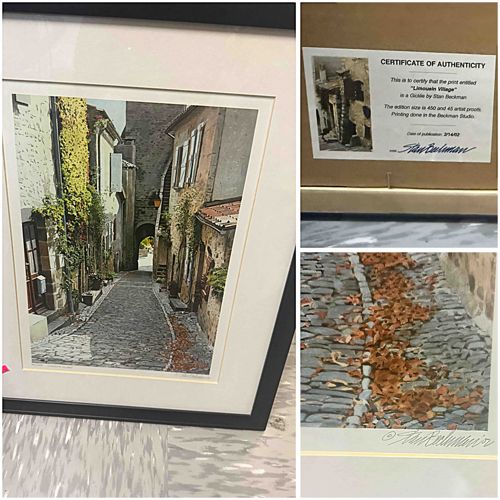
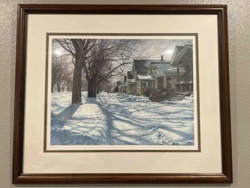
This item is a framed giclée print titled "Limousin Village" by artist Stan Beckman. The print depicts a narrow, picturesque cobblestone alleyway in what appears to be a European village, likely Limousin, France, as per the title. The architectural style suggests rustic stone buildings, one on the left covered extensively with ivy or climbing vines, indicating age and character. The color palette is earthy and subdued, featuring various shades of gray, brown, and green, with accents of orange and yellow from scattered autumn leaves on the cobblestones. A prominent archway is visible at the end of the alley, framed by buildings. The print is professionally presented in a dark-colored, likely black, frame with a wide, off-white or cream-colored mat, enhancing the artwork's visual appeal and providing a buffer from the frame. A close-up reveals intricate details in the cobblestone texture and the delicate depiction of fallen leaves, suggesting high-quality printing. The artist's signature, 'Stan Beckman,' appears in the lower right corner of the print itself. A 'Certificate of Authenticity' affixed to the back confirms that it is a giclée by Stan Beckman, states the edition size as '450 and 45 artist proofs,' and notes that 'Printing done in the Beckman Studio.' The date of publication is 2/14/02. The visible condition appears excellent, with no apparent tears, creases, or major discoloration on the print. The frame and mat also seem to be in good condition. The giclée printing technique indicates a high-quality reproduction method, known for its archival properties and fidelity to the original artwork, making it a valuable collectible for admirers of Stan Beckman's work or French village scenery.
AI Appraisal Report
Upon examination of the images provided, this item is identified as a framed giclée print titled 'Limousin Village' by Stan Beckman, published on February 14, 2002. My assessment is based on the visual characteristics of the artwork, the artist's signature in the lower right, and the Certificate of Authenticity affixed to the verso. The certificate indicates an edition size of 450 with 45 artist proofs, printed in the Beckman Studio. Visually, the print, matting, and frame appear to be in excellent condition, with no observable damage, fading, or foxing. The giclée printing process and the professional framing contribute positively to its presentation and preservation.
The market for Stan Beckman's giclée prints is moderately active, appealing to collectors of his work and enthusiasts of scenic European village art. Comparable sales for similar-sized, signed, and numbered giclée prints by Beckman typically fall within the $150 to $300 range at auction and through secondary market galleries. This specific edition size of 495 (450 + 45 APs) is relatively standard for prints, making it accessible rather than exceptionally rare, which influences its value.
It is important to note that this appraisal is conducted based on images and supplied information. A definitive authentication cannot be completed without a physical inspection. For full authentication, I would need to examine the print out of the frame to inspect the paper, print quality, and any potential watermarks. Verifying the signature against known authentic examples and confirming the certificate's legitimacy against the artist's or publisher's records would be required to establish irrefutable provenance.