These notes were written by the person who submitted this item. Appraiser.AI has not verified them, and the AI's identification and estimate may rely on them.
AI Estimated Value
Not an official valuation
$400-700
AI estimate as of August 22, 2025 · verify with a professional before acting
AI-Generated · Verify before acting
Everything on this page is generated by AI for informational purposes only. AI can make mistakes — the AI may misidentify items or misattribute them (artist, maker, brand, designer, origin, era). This is not an official valuation and should not be used for insurance, sale, tax, estate, legal, or lending purposes — or any decision requiring a certified appraisal. It is not an authoritative claim about any person, brand, or rights holder — do not share or rely on it as a factual statement about a third party. Always consult qualified professionals before making financial decisions.
This analysis also relies on unverified notes provided by the user, which may be incomplete or inaccurate and could affect the result.
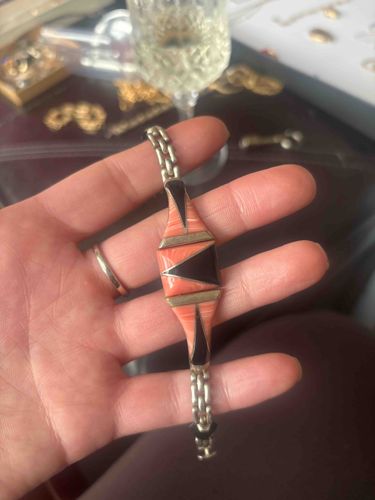
This exquisite piece is a vintage Southwestern-style bracelet, likely crafted from sterling silver judging by the typical aesthetic of such pieces that utilize similar inlay techniques. The central focal point is a geometric inlay design, featuring a striking combination of natural coral and black onyx or jet. The coral segments, displaying a warm, variegated peach-to-salmon hue, are cut into tapered trapezoidal or triangular shapes, exhibiting natural growth patterns and faint striations characteristic of genuine coral. These are interspersed with sharp, triangular inlays of a deep, opaque black stone, possibly onyx or jet, creating a strong contrast and a dynamic visual effect. The inlay work appears precise, with the stones closely fitted together and framed by slender silver channels, indicative of quality craftsmanship typical of Native American or Southwestern artisan work. The main inlaid section is symmetrical and tapers towards both ends, connecting to a multi-link chain on either side. The chain links appear to be of a sturdy, possibly snake chain or tightly woven 'wheat' chain style, crafted from silver, complementing the main design without detracting from it. Visible condition appears good with a natural patina on the silver, suggesting age and consistent wear. No obvious damage like cracks in the inlay stones or significant dents in the silver are immediately apparent, though closer inspection would be required to confirm. The aesthetic strongly points to mid-20th century, possibly 1960s-1980s, Southwestern artisan work, where coral and onyx were popular materials for intricate mosaic or channel inlay. The quality of the stone cutting and the neatness of the silver work suggest a skilled craftsperson. There are no visible maker's marks or signatures in the provided image; these would typically be found on the reverse side of the centerpiece or on the clasp.
AI Appraisal Report
Upon examining the provided image of the Southwestern Coral and Onyx Inlay Silver Bracelet, my initial assessment suggests it is a well-crafted vintage piece. The geometric inlay, combining natural coral (displaying characteristic striations and color variations from peach to salmon) with what appears to be black onyx or jet, is precise. The stones are tightly fitted within slender silver channels, indicative of quality channel inlay work typical of Native American or Southwestern artisans. The silver chain, likely sterling, complements the main design effectively. Its visible condition appears good, with a desirable natural patina suggesting age and consistent wear without obvious damage like cracks or dents. This aesthetic strongly points to a mid-20th century origin, likely 1960s-1980s, a period when coral and onyx were popular materials for such mosaic inlay techniques in this region.
Authenticity: While the quality and style strongly suggest this is a genuine Southwestern artisan piece, full authentication is limited by image-only examination. An in-person inspection would allow for examination of the reverse side for maker's marks, hallmarks (e.g., "sterling," "925"), or artist signatures. These marks are crucial for definitively attributing the piece to a specific artist or tribe, which can significantly impact value. Furthermore, physical examination allows for tactile assessment of the weight, construction integrity, and confirmation of stone type through spectroscopy if necessary. Provenance documentation (e.g., original sales receipts, historical records) would also enhance authentication.
Market Conditions & Demand: The market for vintage Southwestern jewelry, particularly pieces featuring natural stones and quality inlay, remains robust. Demand is steady for authentic, well-preserved examples. Comparables in the current market suggest that similar bracelets by unidentifiable but skilled artisans can fetch values based on material quality, craftsmanship, and condition. Rarity is moderate; while many such pieces were made, those with this level of presumed craftsmanship and condition are less common.
Value Factors: Key factors impacting value include the presumed sterling silver content, the natural coral and onyx inlay quality, the precision of the craftsmanship, and its good vintage condition. The absence of a visible maker's mark limits the top-end potential value, as attributed pieces by renowned artists achieve higher prices.
Limitations: Without physical inspection to verify silver purity, confirm stone types definitively (e.g., distinguishing onyx from jet), and search for maker's marks, the appraisal is based on visual characteristics and historical market trends for comparable unattributed pieces.