Photo and notes provided by the user — not generated by AI
Submitted photo · June 6, 2026
User's notes
No additional notes provided.
AI analysis below
AI appraisal
AI analysis & estimate
AI-Generated · Verify before acting
Everything below is generated by AI for informational purposes only. AI can make mistakes — the AI may misidentify items or misattribute them (artist, maker, brand, designer, origin, era). This is not an official valuation and should not be used for insurance, sale, tax, estate, legal, or lending purposes — or any decision requiring a certified appraisal. It is not an authoritative claim about any person, brand, or rights holder — do not share or rely on it as a factual statement about a third party. Always consult qualified professionals before making financial decisions.
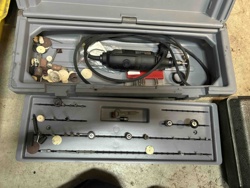
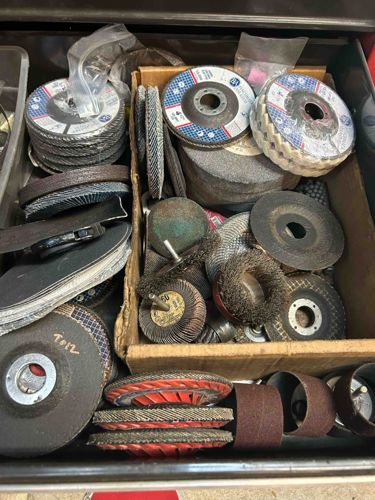
This item is a collection of various abrasive and grinding discs and brush attachments, typically used with angle grinders, die grinders, or rotary tools. The collection is housed within what appears to be a drawer or compartment, likely part of a toolbox or storage unit, and is organized somewhat haphazardly, indicating regular use or storage of miscellaneous stock.
Physical characteristics vary widely within the collection. There are numerous circular abrasive discs, primarily in shades of gray, black, and brown, with some featuring blue and white branding visible on their labels. These discs come in different diameters, ranging from approximately 3-4 inches up to possibly 7 inches, and exhibit various grit levels as suggested by their textures, from smooth finishing discs to coarser grinding wheels. Many of the flap discs, designed for sanding and finishing, are visible with their characteristic overlapping abrasive flaps, particularly some with orange or red plastic backing. Some discs show central holes for mounting onto spindles or arbors.
Beyond the abrasive discs, there's a significant assortment of wire brushes of different shapes and sizes, including cup brushes, wheel brushes, and end brushes, mainly constructed from metal wire bristles, which appear to be brass or steel, and are somewhat discolored from use, showing a greenish patina on some. There are also sanding bands or sleeves, cylindrical in shape, suggesting use with a drum sander or similar tool.
Visible condition issues include general wear and tear, dust, and discoloration consistent with a workshop environment. Some discs show edges that are chipped or rounded from use. The wire brushes exhibit bent or worn bristles. Patina is evident on some metal components. While no specific manufacturer's marks are clearly discernible on all items, some branding is visible on the larger circular discs (e.g., blue and white labels). One black disc has 'T012' written on it in what appears to be white marker, possibly an internal inventory or size marking. The overall age of the collection is difficult to ascertain precisely, but it appears to be a mix of relatively new and used consumables, likely from the contemporary period given the materials and types of abrasives.
The quality and craftsmanship vary as expected in a mixed lot of consumables from different probable manufacturers; however, they appear to be standard industrial or professional-grade items, designed for durability and performance in material removal and surface preparation tasks.
AI Appraisal Report
·AI can make mistakes·Verify before acting
Upon visual examination of this collection of assorted abrasive and grinding discs with wire brushes, it's clear these are heavily used consumables from a workshop environment. The condition varies significantly, showing general wear, dust, discoloration, and evidence of use such as chipped edges on discs and bent bristles on wire brushes. The 'T012' marking on one disc suggests internal inventory, not necessarily a brand. Authenticity of individual items as legitimate industrial tools is generally good based on apparent quality, though specific manufacturer verification without clear branding is difficult.
Market conditions for used consumables like these are low. While new equivalents fetch a moderate price, a mixed, used lot with visible signs of wear and incomplete sets reduces their individual and collective value significantly. Comparables would be similar used tool lots or bulk sales of workshop surplus materials.
Demand for such a miscellaneous collection is primarily from hobbyists or small workshops looking for very inexpensive stock. Rarity is non-existent; these items are common industrial consumables. Factors impacting value negatively include the used condition, haphazard organization, unidentifiable brands for most items, and the inherent nature of consumables which lose value with usage.
Limitations for full authentication from images alone are significant. I cannot inspect physical integrity, grit levels, or material composition. In-person examination would allow for tactile assessment of wear, identification of obscured branding, and confirmation of material quality. Provenance documentation would confirm origin, and scientific testing could verify material composition or specific abrasive types, though this is excessive for such an item.